


As of 1 July 2025, Malaysia’s broadened Service Tax (SST) framework has officially come into force, placing financial services under closer regulatory scrutiny.
The policy shift, first introduced in Budget 2025, represents a fundamental recalibration in the way financial services are taxed.
While the primary objective is to strengthen fiscal sustainability by expanding the tax base, policymakers have opted for a deliberate, layered approach to avoid disrupting essential banking services relied upon by the public.

Do note that not every service is impacted, but those that are, could necessitate rethinking internal processes, pricing models, and customer-facing disclosures.
What Falls Within the New SST Scope?
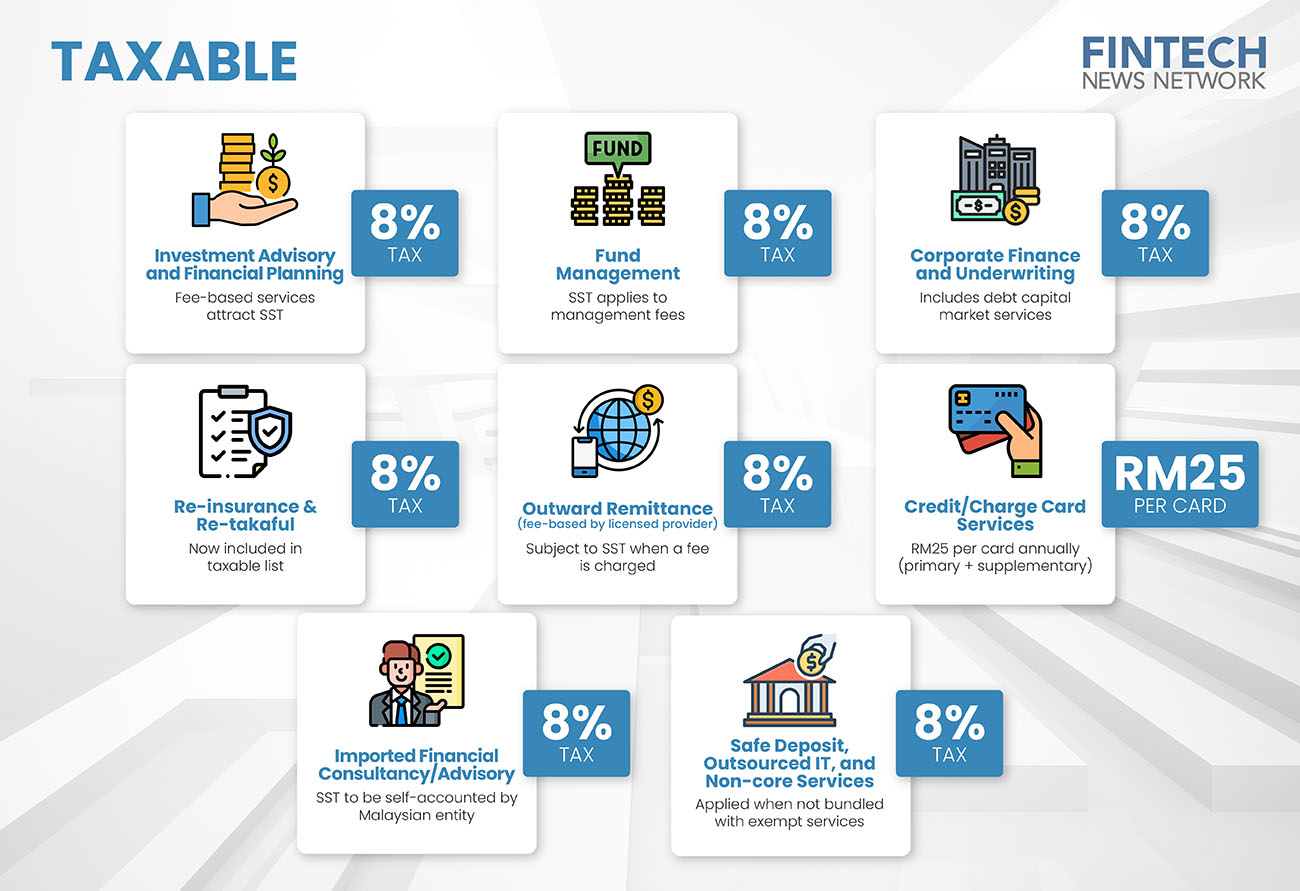
The heart of the expansion lies in its focus on fee- and commission-based financial services. Where such fees are imposed, a standard 8% service tax now applies.
This includes a spectrum of services. They range from investment advisory and financial planning to corporate finance, fund management, and capital market transactions.
It’s important to distinguish that while fees for facilitating trades or managing funds are taxable, the profits or gains made from these capital market activities themselves remain exempt.
Reinsurance and re-takaful arrangements are also now subject to service tax under the expanded regime.
Outward remittance services are also taxable when fees are imposed by licensed providers. For instance, if a bank or financial institution charges a customer for transferring funds overseas, that service is subject to SST at 8%, as outlined in the updated guidance.
In the case of credit and charge cards, the government has retained a fixed charge structure of RM25 per card, applicable to both conventional and Shariah-compliant cards.
The SST scope has also been widened to include imported financial services.
When a Malaysian entity engages a foreign-based advisor for investment or financial consultancy services, that company is now required to self-account for the 8% tax, effectively neutralising any tax arbitrage from offshore sourcing.
Non-core digital services tied to financial operations are also included. These span safe deposit facilities, outsourced IT maintenance, and value-added advisory support, particularly when unbundled from core banking activities.
What Remains Outside the Tax Bracket?
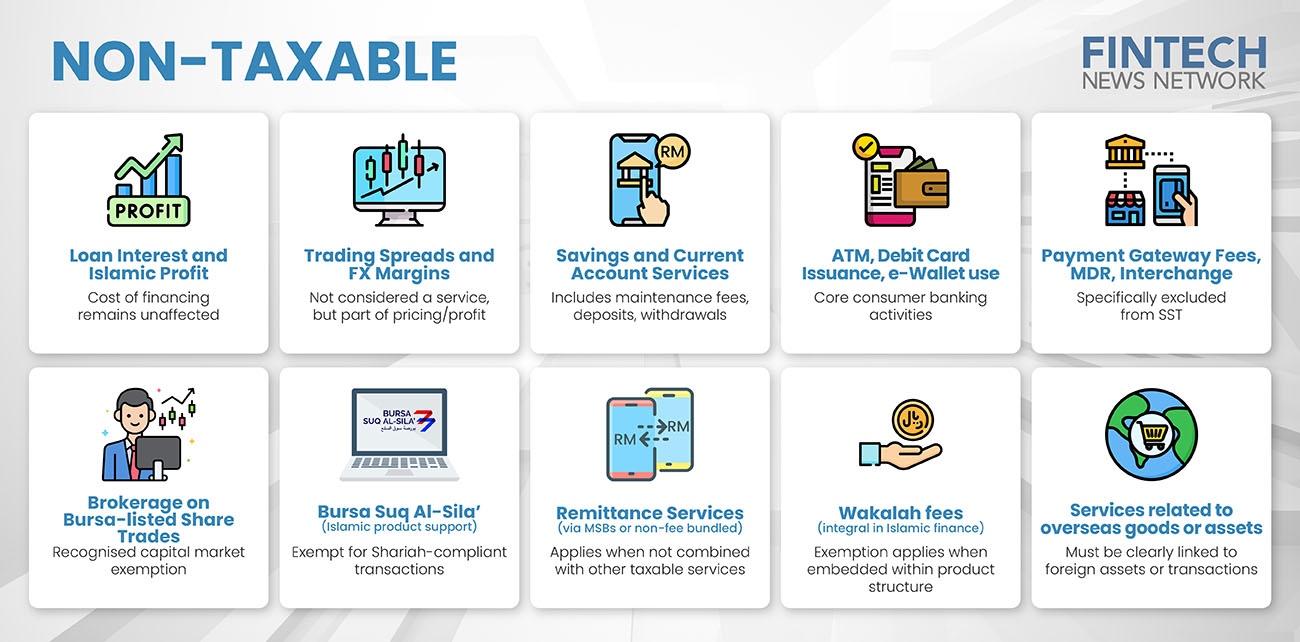
Despite the broader net, the government has been intentional in shielding key services from tax exposure.
Interest on loans and profit elements tied to Islamic financing remain exempt. This ensures the core cost of capital remains unaffected, which is crucial for maintaining credit access and affordability.
Similarly, income from trading spreads or foreign exchange margins is excluded, as these represent inherent profit mechanisms rather than rendered services.
Basic transactional banking activities also fall outside the SST scope. Account fees related to savings and current accounts, e-wallet usage, ATM withdrawals, debit card issuance, and local fund transfers are all excluded. Charges associated with online payment gateways and merchant discount rates are similarly protected.
There are specific carve-outs to support capital market activity. Brokerage fees for Bursa Malaysia-listed equity trades, as well as clearance and listing-related charges by Bursa itself, are exempt. The same holds true for charges on the Bursa Suq Al-Sila’ platform for Shariah-compliant instruments.
Services linked to international trade and cross-border asset holdings are also exempt, so long as the service relates directly to non-Malaysian goods or properties.
Unlike outward remittance, normal remittance services are explicitly excluded from the SST scope. It is particular to those provided by money services businesses (MSBs) and similar entities.
This exemption ensures that domestic and cross-border remittance services remain accessible and affordable for the general public and foreign workers. These services, when not bundled with other taxable offerings, do not attract SST.
A Special Case for Labuan Financial Services
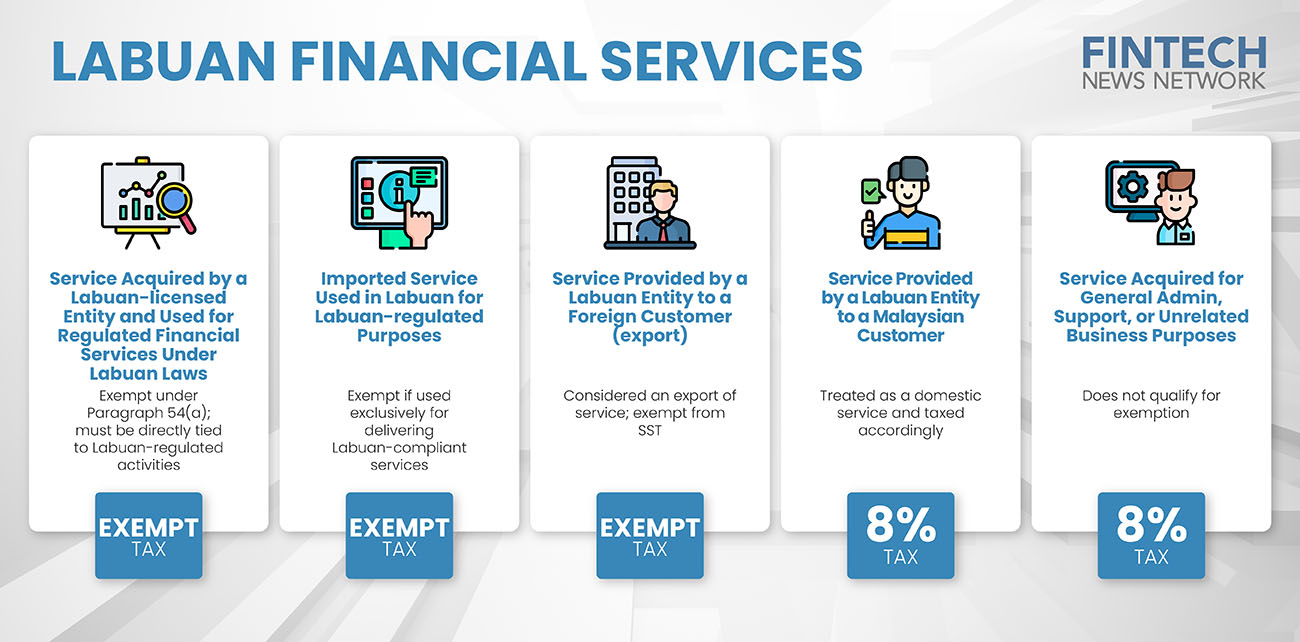
Labuan financial services are not automatically exempt under the expanded SST regime.
According to the latest guidance, these services are only exempt if they meet strict conditions. Specifically, the exemption applies when the service is acquired by a Labuan-licensed entity and is used to provide regulated financial services under Labuan laws.
Additionally, imported services used in Labuan can also be exempted. Best to remember that it is provided that they directly contribute to the delivery of Labuan-regulated financial activities. In addition, if the Labuan entity provides services to a foreign client, the service is considered exported and thus exempt from SST.
If the services are acquired for general operational purposes, however, or are not linked to regulated financial functions under Labuan jurisdiction, then SST may still apply.
This also includes services provided by a Labuan entity to a customer in Malaysia. They are subject to SST, as they are treated as domestic services.
In short, exemptions for Labuan are conditional rather than blanket. Each transaction should be reviewed in context to determine whether it qualifies based on its purpose, regulatory alignment, and the residency of the service recipient.
Timeline and Transitional Relief
To ease adoption, the tax rollout is being executed in two stages. The first phase, which began on 1 July 2025, applies to services listed in Appendix A of the RMCD’s guide. Phase two will commence on 1 September 2025 and capture all remaining services that were not included initially.
Notably, newly required businesses that register by 31 August 2025 will only be expected to begin charging SST from 1 September. It may help in providing additional breathing room for the operational setup
In recognition of the operational lift required, the authorities have introduced a compliance grace period. Businesses that make sincere efforts to align with the new rules will not face penalties or prosecution before 31 December 2025.
The registration threshold for financial services has also now doubled to RM1 million in annual taxable turnover, up from RM500,000. This offers some relief to MSMEs and newer fintech entrants who may otherwise have faced early compliance obligations.
Entities falling below the threshold can choose to voluntarily register. However, do keep in mind that mandatory compliance applies only if the revenue ceiling is exceeded within a 12-month period. Registration is facilitated via the MySST platform.
What Does This Mean for the Industry?
For larger banks, insurers, investment managers, and other regulated financial entities, the changes require a significant operational response.
Internal systems must be updated to apply the correct rates, staff must be trained, and clear client communications must be prepared to explain any new charges.
Consumers, on the other hand, are unlikely to feel the pinch when it comes to their day-to-day transactions. Most core banking services are untouched, and where charges do apply, industry groups must commit to transparency
From a macroeconomic perspective, analysts expect the overall inflationary impact of this SST revision to be minimal. Forecasts from local investment banks suggest a potential CPI effect of around 0.1% to 0.2% annually. This is largely because most essential services, including food (some of it), healthcare, and basic utilities, remain exempt.
Financial institutions have until the end of the year to get their systems and filings in order. For consumers and businesses alike, the key will be understanding which services fall within the tax net and which remain exempt.
As with any regulatory shift, clarity and communication will be essential to ensure a smooth transition.
If the financial sector plays its cards right, this tax change could be absorbed with minimal disruption. Plus, it could have better transparency for all of the involved stakeholders.
The next few months will be crucial.
Featured image: Edited by Fintech News Malaysia, based on image by user6309018 via Freepik.
