Has GXBank Delivered the Financial Inclusion Digital Banks Promised?
Deputy CEO Hildah Hamzah explains how the bank underwrote Malaysia's first-time borrowers profitably, and where digital banks still fall short on inclusion.
Get the hottest Fintech Malaysia News once a month in your Inbox
Sole proprietors do not always get treated well when they walk into a bank branch to ask for a loan, said Hildah Hamzah, Deputy CEO and Chief Operating Officer of GXBank.
Some of them do not look the part, they do not sound the part, and the embarrassment of admitting they need help keeps many away from formal credit altogether.
GXBank’s own lending data shows how many had been left outside the system.
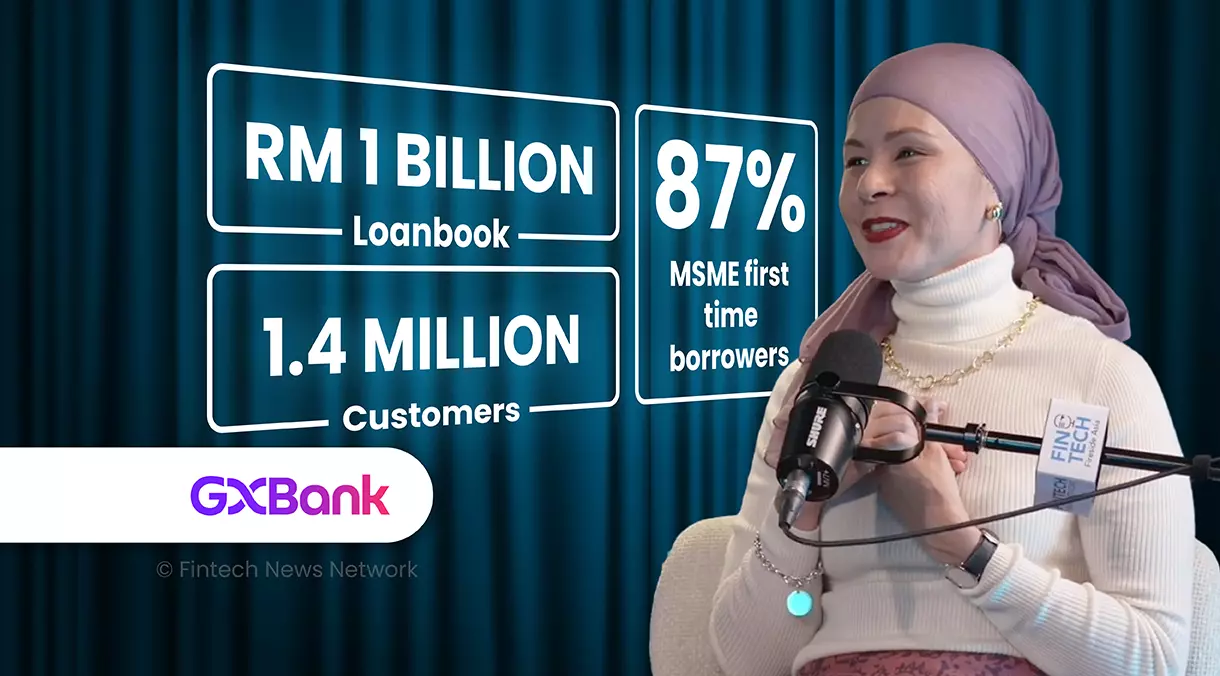
Of the digital bank’s MSME borrowers, 87% had never held a loan before, Hildah told Fintech News Network’s Fintech Fireside Asia podcast.
GXBank had also just released a fresh batch of figures, which is what brought Hildah onto the podcast in the first place.
By her account, GXBank crossed RM1 billion in loans in a single month for the first time recently, and its deposit book has also passed RM1 billion.
More than 60% of its depositors come from the B40 and M40 income brackets, Malaysia’s bottom 40% and middle 40% of households by income.
Just over 30% of retail depositors show spending patterns, such as recurring advertising payments, that look more like a small business than a personal account.
Hildah explained that pattern is what pushed GXBank to build a lending product for the segment already visible in its own customer base.
Underwriting Borrowers Other Banks Turn Away
GXBank’s approach to micro and small business lending centres on combining personal and business bank statements through its own credit models.
An approval can take as little as ten minutes, or up to 24 hours where a third-party guarantee is involved.
The guarantee comes from CGC Digital, the fintech arm of Credit Guarantee Corporation Malaysia Berhad.
The bank also agreed to accept personal bank statements from sole proprietors who had never formally separated business money from personal money.
Malaysia’s MSME financing gap runs to an estimated RM90 billion, according to GXBank, and this is the slice it is aiming at.
Ask Hildah who this segment actually is, and she doesn’t dress it up.
“When you’re a sole proprietor, you don’t look the part, you don’t sound the part,” she noted, describing the reception some small business owners get at traditional bank branches.
Hildah Hamzah
“It’s embarrassing, isn’t it? You don’t understand the paperwork, and sometimes people don’t have the patience for you. The fact that you can do this in the privacy of your own home means you don’t need to feel embarrassed.”
Inclusion Still Needs a Business Model
Put the profit-versus-purpose question to Hildah directly, and she doesn’t hedge.
Her answer goes back to zakat, the Islamic practice of giving a portion of one’s wealth to those in need.
“You can only pay zakat when you make money,” she said. “Every business that wants to do good must first feed itself and take care of the people that work for it.”
In her order of operations, the bank first has to take care of its staff, meet shareholder expectations and remain responsible for depositors’ money.
Only then, she argues, can the bank keep serving underserved customers at scale.
It is not just philosophy, either. Malaysia’s digital banks face a five-year deadline to graduate out of their foundational operating restrictions, and BNM’s DIME framework ties that graduation directly to inclusion outcomes.
“If you don’t serve that developmental inclusion mandate, you don’t graduate,” Hildah argued, “and any bank that doesn’t graduate will not be profitable.”
Easier credit is where financial inclusion becomes more complicated. Vincent asked Hildah directly whether expanding credit access risks sliding into what some behavioural economists call engineered consumerism.
Push her on this, and she points to what GXBank’s own borrowers actually do with the money.
FlexiCredit, the bank’s revolving credit line for retail customers, gets drawn down mostly for medical bills and car repairs, she added, not discretionary spending.
“There’s a difference between consumptive and frivolity,” she pointed out.
She stops short of condemning consumptive borrowing outright. Smoothing cash flow or covering a large one-off expense counts as a legitimate use of credit in her book.
Vincent pointed to what he considers genuinely destructive instead. A buy-now-pay-later loan for a concert ticket, say, or a fast-food promotion tied to a celebrity endorsement.
Hildah’s answer circled back to financial education. Consumptive borrowing becomes less dangerous, in her view, when people understand cash flow and can tell a need from a want.
Teaching Malaysians to Be Celik Kewangan
The same emphasis on understanding money, not just accessing it, runs through GXBank’s financial literacy arm, which it calls Celik Kewangan.
It sits inside a broader programme named Impian Gigih that also funds scholarships and school bursaries.
Close to 20 students have received GXBank scholarships across three cohorts, and its education partnerships, GXBank notes, have reached more than 12,000 Malaysians.
An end-of-year financial literacy survey found that 71% of respondents found GXBank’s content helpful. Hildah credits that to keeping the material practical and jargon-free rather than condescending.
She traces some of the gap in financial literacy to culture rather than curriculum.
“As Asians, and I’m generalising, face matters a great deal,” she reflected. “When you’re short on money, you’re not going to be able to say you need help, that you need advice, that you need someone to help you restructure your finances. Culturally, we don’t do that, so what happens is, it spirals.”
Her own comfort with money traces back to a lesson learned the hard way at age seven, when she sold her mother’s feather duster to classmates feather by feather after they ran short of materials for a school art project.
Like many Malaysians who do the same, she got in trouble for it afterwards.
Hildah learned money through instinct, family habits and a little childhood opportunism.
The story matters because it shows how uneven financial education can be, because many Malaysians, she argues, never get even that starting point.
Aiming to Go Beyond Klang Valley
Such an unevenness shows up in GXBank’s own numbers too, where when she was asked what she wishes the bank had done better, Hildah did not hesitate.
Its customer base remains heavily concentrated in Klang Valley, with weaker representation in other states despite a solid base in Sabah and Sarawak.
The user base also skews toward a narrower age band than she would like.
“It’s Malaysia’s first digital bank, not Klang Valley’s first,” she remarked, hinting that GXBank plans to broaden its geographic reach in the coming months.
Retail Trust Is Different From MSME Trust
Ask how GXBank builds trust without a single branch, and she splits the answer in two.
Retail trust, she argues, has less to do with physical presence than with staying relevant, especially since close to 98% of Malaysians already own a mobile phone.
She pointed to a case where a customer’s card was suspected of fraud and fully resolved, replacement card included, in under 20 minutes.
The same customer who had previously lost RM3,000 to a similar scheme at another provider.
But MSME trust works differently, in which she describes it as “trust by proxy,” built through community relationships and partnerships rather than a bank’s own brand alone.
Something that demands far more hands-on relationship building than GXBank’s retail business has ever needed.
Could Financial Inclusion Eventually Look Like Advice?
Beyond lending, Hildah floated a longer-term role for AI.
“Can I give you private banking without you even knowing it’s private banking?” she said. “Technically, a digital bank is built to do that.”
She imagines a system that spots idle cash sitting in a savings account and suggests how to reallocate it for a better return, the kind of advisory service usually reserved for wealthier clients.
I pushed back on the risk of automated advice steering someone into a volatile asset class.
Hildah’s answer came back to financial literacy rather than technology, sizing any suggestion to what a saver can actually absorb.
“You’re not going to ask them to invest in crypto and stablecoin,” she said. “You can’t, because they can’t withstand the hit.”
Hildah’s Development Finance Roots Still Show
Her appetite for reinventing what a bank can do traces back to her own path into one.
She is the first in her family to attend university. Her mother is Peranakan Chinese, her father served in the army, and she credits both with instilling a sense of duty to serve beyond herself.
She consciously chose development finance because of it, working at Bank Pembangunan Malaysia Berhad before GXBank existed.
Hildah joined GX Bank Berhad, which trades as GXBank, as employee number three, and has helped grow the team to around 400 people since.
Her path from development finance to building a bank from scratch shows in how carefully she talks about what comes next.
She stops short of overpromising on GXBank’s next moves, but confirms the medium-term plan is to expand what it offers MSMEs beyond its current sole-proprietor focus, alongside the push into new states.
“We hope, in a year, there’ll be an increased awareness of ourselves for all Malaysians,” she said.
Catch the full conversation on Fintech News Network’s Fintech Fireside Asia podcast as Hildah goes deeper there into GXBank’s numbers, its MSME strategy, and where Malaysia’s financial inclusion push still has work to do.