Alex Tan Wants to Make an IIMMPACT on Malaysia’s Digital Payment Rails
Originally launched as a consumer e-wallet, IIMMPACT pivoted to become a B2B Platform-as-a-Service provider, offering a single Application Programming Interface (API) for over 20,000 digital services.
Get the hottest Fintech Malaysia News once a month in your Inbox
Every time a Malaysian pays a utility bill, tops up a prepaid line, or redeems a digital voucher inside a banking app, there is an entire infrastructure layer working quietly in the background.
Most users won’t realise it exists, and that is precisely the point.
“The best infrastructure is an infrastructure that nobody actually thinks about,” says Alex Tan, CEO of IIMMPACT Sdn Bhd.
Alex Tan
“Today, if you turn on your light switch, you wouldn’t think about the power grid. You just know that electricity is there.”
For Alex and his team, the payment infrastructure should work the same way. Invisible, reliable, and always on.
Yet the simplicity users experience today did not happen by accident. Behind the scenes, the payments ecosystem grew through years of one-to-one integrations between banks, billers and digital service providers.
Each new connection took time to negotiate, build and maintain.
As the number of services expanded, so did the complexity.
For financial institutions, innovation often slowed under the weight of integration work, and for consumers, access to digital services could vary depending on which platform they were using.
From Consumer Wallet to Infrastructure Layer
IIMMPACT did not start out as infrastructure. When the company launched in early 2018, it was a consumer-facing e-wallet operating in an environment that was just beginning to heat up.
Large players were entering aggressively, marketing budgets were swelling, and customer acquisition costs were rising fast.
The team realised that competing at the front end of the market would require capital and scale that did not align with their long-term strengths.
Instead of fighting for consumer attention, they pivoted to something more foundational.
The founding team of IIMMPACT in the company’s early days.
“Think of us like an aggregation layer,” Alex explains.
Today, IIMMPACT operates as a Platform-as-a-Service provider, offering a single API that connects banks, digital banks, e-wallets and enterprise platforms to more than 20,000 digital services.
Through a single integration, partners can immediately access services ranging from bill payments and telco reloads to eSIMs, gift cards and loyalty point transfers.
If a bank wants to expand its in-app biller catalogue, or a wallet wants to introduce new digital services quickly, IIMMPACT becomes the infrastructure bridge.
There is no need to manage dozens of individual integrations or vendor relationships. The aggregation work is already done.
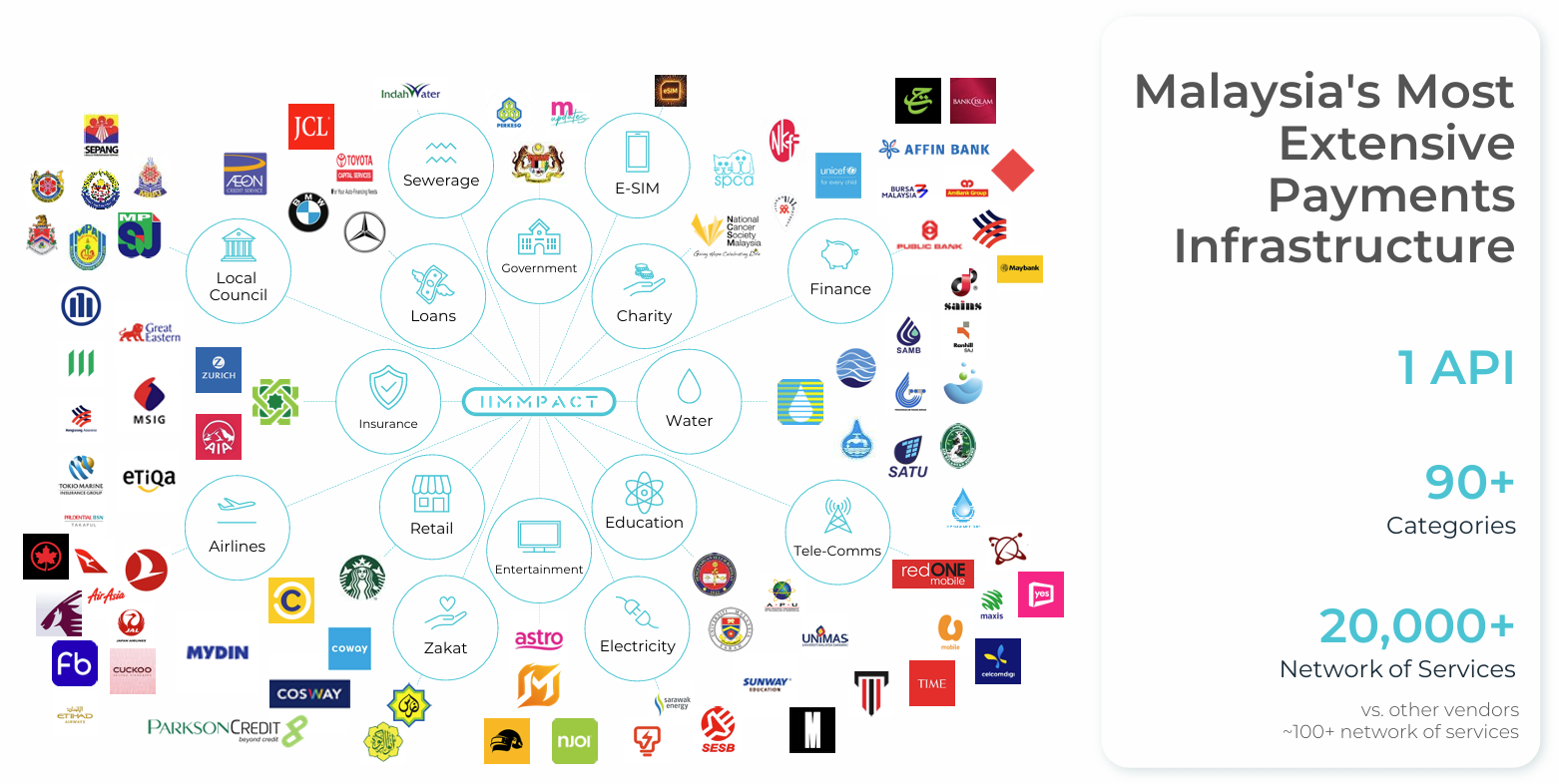
An illustration detailing IIMMPACT’s ability to streamline connection to over 20,000 services across 90+ categories into a single API integration, contrasting significantly with standard vendor networks.
That strategic shift from B2C to B2B infrastructure marked a turning point.
Backed by Peak XV Partners (formerly Sequoia India & Southeast Asia) alongside other institutional and angel investors, IIMMPACT now processes over RM1 billion in annual transaction value and powers a growing list of financial institutions and digital platforms across Malaysia.
Scaling to Bank-Grade Standards
The real inflection point came when digital banks entered the picture.
Serving fintech players is one thing. Serving regulated banks introduces a completely different compliance threshold.
Alex recalls the moment the team received detailed cybersecurity and risk assessment checklists from their banking clients. It was a wake-up call.
From penetration testing requirements to network diagrams, sanction screening and anti-money laundering controls, the requirements became more stringent.
IIMMPACT responded by strengthening its compliance framework, obtaining ISO/IEC 27001:2022 certification and embedding automated sanction screening into its platform.
The result was not just regulatory alignment but operational resilience.
“For the entire 2025, our uptime is 100%. Not 99.99, it is 100%,” Alex says.
The infrastructure today is capable of handling around 30,000 transactions per second as it supports approximately 90 product categories, covering everything from electricity and water payments to zakat and insurance services.
Behind these transactions sit real-time processing and bank-grade safeguards.
For partner institutions, that reliability translates into customer trust. In fact, the company has maintained a 97% client retention rate since its founding.
For IIMMPACT, that track record has become a competitive advantage.
A Neutral Bridge in the Ecosystem
As the company matured, ecosystem access became just as important as technical capability. This is where the PayNet Fintech Hub entered the picture.
Alex describes the relationship as one of the company’s defining moments. The conversations with PayNet’s team were not framed around sponsorships or surface-level networking.
Instead, they centred on a larger question about how to grow the ecosystem collectively.
Members of the IIMMPACT team during a collaborative session at the PayNet Fintech Hub.
“The first question that we kind of brainstormed together was, how do we actually make the whole ecosystem bigger together?”
In a national payments system shaped largely by banks and regulated infrastructure, neutrality helps keep the ecosystem moving.
It creates a space where competitors can collaborate, test ideas and form partnerships without concerns about favouritism. That sense of fairness is often what allows innovation to scale beyond individual institutions.
That positioning matters.
For fintech founders operating in a B2B environment, access to the right decision-makers can determine whether months are spent navigating corporate hierarchies or accelerating into meaningful partnerships.
“They’re not just doing networking, they’re basically actively match-making us,” Alex says. “They saw the match, and then they brought us to the table.”
Through the Hub, IIMMPACT was introduced directly to bank leadership teams and infrastructure partners that would have otherwise taken significant time and effort to access.
In many cases, these early connections lead directly to pilot projects and collaborative testing between institutions that might not otherwise engage with one another.
When conversations start sooner, technical and operational alignment tends to follow, making it easier for new services to move from development into real-world deployment.
For a technology-led founding team, that access bridged a critical gap between product capability and institutional adoption.
Beyond introductions, the Hub provides shared services, cloud credits, co-working space and POC’s funding support, such as the PayNet Credit.
While IIMMPACT had previously participated in other accelerator programmes, Alex views the real value of the Hub as relational rather than transactional.
It is about being placed in rooms where strategic conversations are already happening.
In a payments ecosystem where banks, fintechs and infrastructure providers must move in sync, neutrality becomes a powerful enabler.
The Hub functions as that bridge.
The CATALYST Effect
In late 2025, Alex and co-founder Kelvin Lee joined the 10-week PayNet Fintech Hub CATALYST programme.
The programme brings selected fintech founders through an intensive series of mentorship sessions, market deep-dives and international exposure designed to help companies refine their strategy and prepare for sustainable growth beyond the startup stage.
As Alex notes, the experience, which included mentorship from Imperial College London, “accelerated the kind of cross-industry collaboration that fintechs can’t build alone.”
Alex and Kelvin during a session at the PayNet Fintech Hub CATALYST programme.
Typically, international exposure pushes startups to benchmark globally and scale regionally. But for IIMMPACT, the programme had the opposite effect.
It sharpened the team’s focus on the opportunity at home.
The timing is particularly significant for Malaysia, especially when digital banks are beginning to scale their customer bases and expand product offerings, while open banking frameworks are gradually taking shape across the financial system.
At the same time, demand for embedded financial services is rising, allowing users to access payments, lending and other services directly within everyday digital platforms without needing to switch between multiple banking apps.
A closer look at the data revealed the sheer size of the domestic gap.
Malaysia’s addressable market for prepaid services and digital bill payments exceeds RM100 billion annually, yet much of it remains offline.
Even processing RM1 billion in transaction value, IIMMPACT has barely scratched the surface.
“We will go deep in Malaysia first,” Alex explained, noting that their market penetration sits below one percent.
“The domestic opportunity alone is enormous,” he continued.
The CATALYST programme helped refine the company’s strategy by reinforcing that Malaysia’s evolving financial landscape offers significant room for deeper market penetration.
Digital banks are still in their early growth phase, and open banking frameworks continue to develop, creating new opportunities for infrastructure providers to scale alongside the ecosystem.
While similar fragmentation exists across Thailand, Indonesia and the Philippines, Alex believes scale should be built through depth before expansion.
In that sense, global exposure did not accelerate regional growth plans but instead strengthened confidence in the company’s core infrastructure model.
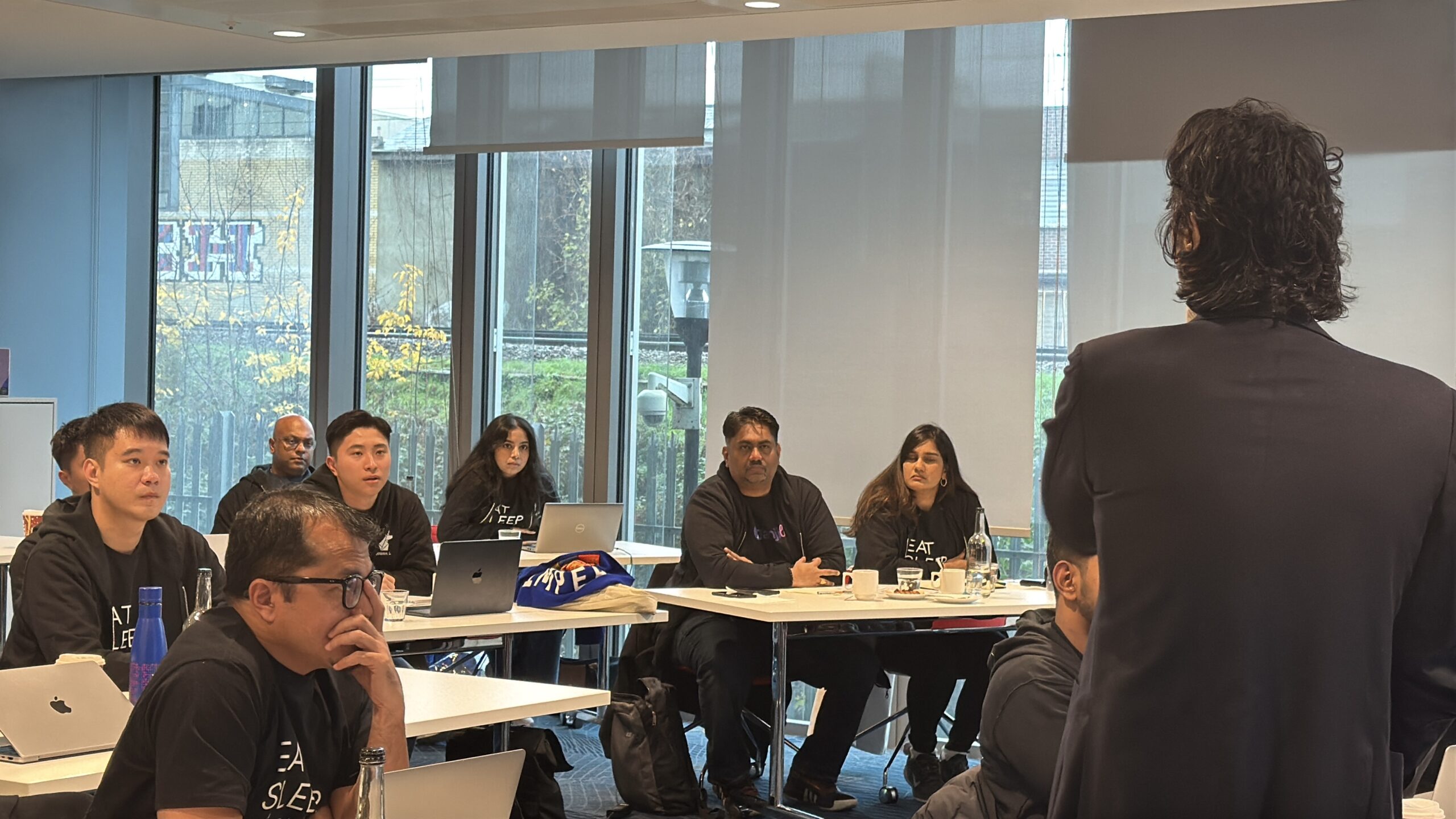
Alex Tan and fellow participants listen intently to Dr Robin Bagchi’s presentation during the PayNet Fintech Hub CATALYST programme.
Infrastructure for the Next Wave
As Malaysia moves toward open banking and deeper embedded finance integration, infrastructure players like IIMMPACT sit in a pivotal position.
Rather than chasing the latest industry buzzwords, Alex focuses on foundational readiness.
“Without foundation, without an infrastructure, we can never build and connect all the dots.”
Whether the conversation is about buy now pay later, embedded finance, agentic AI or real-time financial insights, each innovation layer ultimately depends on reliable transaction rails.
Data flows, reconciliation, identity verification and compliance screening all need to operate seamlessly in the background.
A Malaysian-Built Backbone
As one of ten homegrown innovators featured under the PayNet Fintech Hub’s broader community and CATALYST initiatives, IIMMPACT is part of a broader shift toward infrastructure-led innovation in Malaysia’s fintech ecosystem.
The country is no longer just adopting global financial technologies. It is building its own rails.
Over the past year, IIMMPACT has moved from powering fintech players to supporting regulated digital banks.
It has achieved ISO certification, implemented bank-grade compliance frameworks and maintained full-year uptime, while expanding service categories and deepening institutional relationships.
Yet, the aspiration remains understated.
The company does not seek consumer recognition but rather operational invisibility.
Infrastructure proves its value not when it is visible, but when it performs flawlessly in the background, day after day, without disruption.
“We don’t measure success by whether anyone knows our name. We measure it by whether the system works — every time, without anyone having to think about it. That’s the point,” Alex Tan, the CEO of IIMMPACT, highlighted.
In a digital economy increasingly defined by front-end innovation and super apps, it is easy to focus on what users can see.
But the long-term resilience of Malaysia’s financial system will depend on the strength of the layers beneath it.
Every payment may begin with a tap on a screen, but its future will depend on the infrastructure resilient enough to carry an entire economy.
The transformation of Malaysia’s payments landscape is already underway and the PayNet Fintech Hub provides the bridge for those ready to turn ambitious ideas into scalable reality.
Become a part of the progress.
This article is part of an ongoing series spotlighting Malaysian fintechs building the future of finance through the PayNet Fintech Hub. Discover the Hub and more fintech startup journeys from Insureku, Cashku, Janjilah, Swipey, Kapitani, Blox, and Moby.
Featured image: Edited by Fintech News Malaysia based on an image by mangpor2004 via Freepik.