74% of Malaysians Use AI to Shop, Yet Half Won’t Let It Make the Purchase
Adyen's 2026 Malaysia Retail Report finds AI is now mainstream in shopping, but weak payment trust could stall the shift towards enabling agentic commerce.
Get the hottest Fintech Malaysia News once a month in your Inbox
Nearly three out of four Malaysian consumers now lean on AI to shop. Most, however, stop short of letting it pay. 52% of respondents are uncomfortable allowing an AI to complete a purchase for them, according to the Adyen Index 2026 Malaysia Retail Report.
Agentic commerce, where AI agents browse, choose and complete a purchase on a shopper’s behalf, is the next step beyond the AI shopping assistants. The report suggests that step could be where Malaysian consumer trust runs out.
The report, commissioned by Adyen and carried out online by YouGov, draws on responses from Malaysian consumers and senior retail managers gathered in March and April 2026.
It covered 1,031 consumers aged 18 and over and 314 retail employees at senior manager level or above, all working for retailers with annual turnover of at least RM75 million.
Lee Soon Yean
“AI is already shaping how Malaysians shop, but the shift from AI shopping assistants to agentic commerce is just beginning,” said Lee Soon Yean, Country Manager, Malaysia, at Adyen.
He added that the harder task for retailers would be building trust across the shopping journey, particularly at checkout, where security, reliability and control matter the most.
Shoppers Now Reach for AI to Cut Through the Noise
Among Malaysians who use AI while shopping, 84% say social media carries too much information to take in, and 74% say AI helps them find inspiration faster than other sources. A further 62% want to use AI to discover unique brands and shopping experiences.
The technology is also more visible across stores and apps. Six in ten AI-assisted shoppers say the brands they buy from have built AI-powered search tools into their interfaces.
Other retail technology is gaining ground alongside it. Self-checkout leads at 39%, followed by brand apps used to check out and collect loyalty points at 26%, and AI tools at 19%, reflecting steady demand for faster, more convenient shopping across channels.
Dato’ Liew Bin
“Malaysian consumers are spending, but they are doing so with greater intention,” said Dato’ Liew Bin, President of the Malaysia Retail Chain Association (MRCA).
He said competing on price alone was no longer viable in a saturated market, and that retailers needed to use technology to meet changing demands and build loyalty through consistent, trustworthy experiences.
Poor Payment Experiences Drive Customers Away
Nearly six in ten Malaysians (59%) say payment errors damage their view of a business, while 26% have abandoned a purchase over security or trust concerns. Another 15% say they would move to a competitor after a poor payment experience.
Retailers face the same pressure from the other side of the counter. Almost all (97%) report being affected by payment performance issues over the past year, and 94% say they have been targeted by or fallen victim to payment fraud.
The fallout runs beyond the transaction itself, adding support and refund costs, abandoned baskets, higher chargebacks and lost sales from failed or slow payments.
If AI agents are to transact on their own, the authentication, fraud controls and reliability behind the checkout could become the main proof points for consumer trust.
Retailers Are Sold on AI, But Wary of the Risks
Despite concerns, Malaysian retailers remain positive about the role of AI in growth. The technology is already embedded across marketing and promotions (40%), customer service and support (39%), as well as customer experience and operations.
Awareness of agentic commerce is rising too. More than eight in ten retailers (85%) say they are familiar with the concept, and 51% say they can explain it confidently. Nearly half plan to invest in AI-driven or agentic commerce tools during 2026.
On the other hand, retailers worry about losing direct customer relationships and brand control, with 38% citing data privacy, security and compliance risk concerns.
Shoppers Now Expect Every Channel to Keep Up
Rising sales tell Adyen that Malaysians are still spending, but more deliberately. Better information lets shoppers weigh value, flexibility and security before they commit, and the smooth checkouts and sharp recommendations they meet online have reset what they expect everywhere else.
That pressure is pushing retailers to meet customers across every channel, because the journey rarely starts and ends in one place. A shopper might search on their phone in the car, browse a mobile app on the train, or walk into a store on impulse, often without buying on the first interaction.
“Consumers are really more diligent in how they spend, and they are provided with information that helps them make better decisions,” said Lee. “They are used to digital retail, by how smooth and fast transactions can be and how good the recommendations are, so they demand the same from every other retailer.”
He said the sale often lands well after that first touch, whether a shopper tries an item in store and buys it there, or returns two weeks later to order online for delivery. Keeping that cross-channel path seamless, in his view, is where retail is heading.
Connected Systems Come Before AI Agents
For many Malaysian retailers, the harder obstacle sits inside their own operations. Around 35% told the survey their current setup suffers from poor data quality or fragmented systems, a gap Adyen argues has to close before agentic commerce can work at any scale.
Adyen’s position is that unified commerce, where a retailer’s online store, mobile app, marketplace and physical outlets all draw on the same data, is the groundwork that makes AI and agentic channels possible. Without it, loyalty points, vouchers and stock that fail to carry across channels leave customers with a disjointed experience.
“If your systems are all connected, it gives you the flexibility to enable these channels much more easily, and to give your customer the same experience wherever they go,” Lee shared.
He framed it as a pattern retailers keep repeating. A few years ago, the hot channel was social commerce, where a shopper clicked a link and was sent back to a website to check out. Now retailers are racing to close the sale inside the chat or the live-selling stream itself, and AI is the next front.
Chasing each new channel one by one could be the wrong instinct, as the goal is a connected platform that lets a retailer plug into whatever consumers move to next.
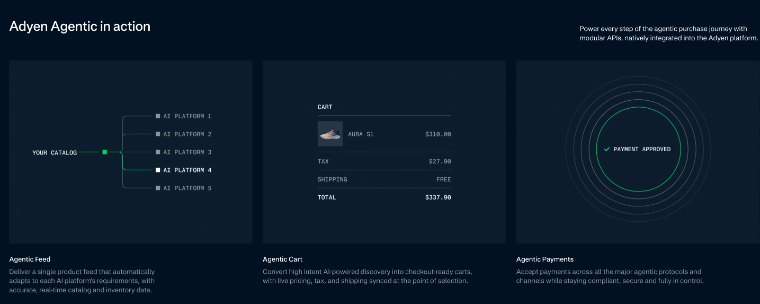
Adyen has moved on that front with the Adyen Agentic suite, launched in June 2026, which aims to let merchants integrate once and sell across multiple AI channels.