Close Menu
    • Fintech Startups Malaysia – List of Fintech Startups and Fintech Companies in Malaysia
    • Fintech Jobs Malaysia
    • About Fintech News Network
    • Work With Us
    • Contact Us
    • Media Kit
    • Advertise With Us
    • Fintech Malaysia Newsletter
    • Submit Fintech Startup
    • Submit Press Release
    • Submit Interview Request
    • Submit Fintech Event
    • Webinar Inquiry APAC
    LinkedIn Facebook X (Twitter) YouTube RSS
    • About
      • About Fintech News Network
      • Work With Us
    • Contact Us
    • Media Kit
    • Advertise With Us
    • Fintech Malaysia Newsletter
    • Submit Press Release
    • Submit
      • Submit Press Release
      • Submit Fintech Startup
      • Submit Interview Request
      • Submit Fintech Event
      • Submit Your Vacancy
      • Webinar Inquiry APAC
    • Fintech Events in Malaysia
    • MY Fintech Startup Directory
    Fintech News Malaysia
    part of Fintech News Network

    Fintech News Network

    LinkedIn Facebook X (Twitter) Instagram YouTube TikTok RSS
    Free Newsletter
    • Blockchain
    • Digital Banking
    • Lending
    • Payments
    • Insurtech
    • Wealthtech
    • Regtech
    • Report
    • Startups
    • Events
    Fintech News Malaysia

    Fintech News Network

    Home»Security»How Did 85% of Synthetic Identities Slip Past Third-Party Fraud Models at Onboarding?
    Security Sponsored

    How Did 85% of Synthetic Identities Slip Past Third-Party Fraud Models at Onboarding?

    The challenge lies in determining whether the identity has a genuine, corroborated data footprint or if it has been artificially constructed to appear legitimate.
    Annette RowenaAnnette RowenaSeptember 25, 20265 Mins Read
    LinkedIn Facebook Twitter Copy Link Telegram Email
    synthetic identity fraud
    Share
    LinkedIn Facebook Twitter Telegram Copy Link Email
    Free Newsletter

    Get the hottest Fintech Malaysia News once a month in your Inbox

    Synthetic identity fraud is one of the fastest-growing fraud types globally, where fraudsters fabricate a person who never existed.

    They typically stitch together a blend of real, stolen, manipulated and invented attributes until the composite is convincing enough to enter through the front door.

    what does a manufactured identity consist of lexisnexis
    Source: Stopping Synthetic Identity and Deepfake Fraud, LexisNexis Risk Solutions

    This shift moves away from years of defensive fraud management thinking. Fraud prevention has almost always focused on stolen credentials.

    Now, attackers no longer need to steal an identity, as they can manufacture one.

    Research from LexisNexis Risk Solutions backs this, indicating that more than one in ten frauds (11%) now involve a synthetic identity, representing an eightfold global YoY increase.

    The most unsettling challenge for fraud prevention teams here is that there’s no longer a victim to raise an alarm immediately.

    Generative AI and deepfakes are making these profiles all the more convincing, and manufactured identities are becoming remarkably difficult to detect.

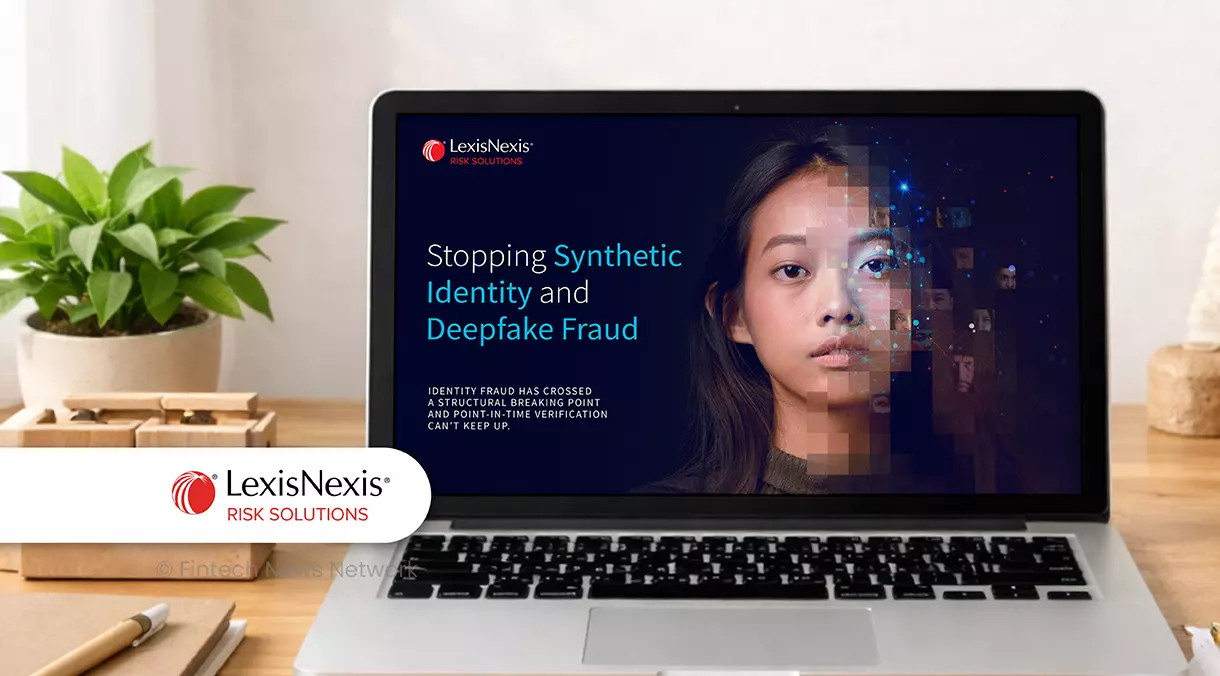
    Research from LexisNexis Risk Solutions’ latest ebook, Stopping Synthetic Identity and Deepfake Fraud, shares that 85% of synthetic identities examined were not flagged by third-party models.

    What’s worse is that synthetic identity fraud is no longer isolated to a single market. It is happening more across regions and industries, and quickly becoming a global issue.

    Which leaves an uncomfortable question for any fraud strategy still optimised for downstream threats: the exposure now sits upstream, at the point of onboarding.

    What can you do about it?

    Why Are Traditional Fraud Strategies Failing?

    Traditional fraud strategies are starting to falter as synthetic identities are largely invisible at onboarding, which is the exact place point-in-time verification collapses.

    When fraudsters can walk in the front door, downstream detection becomes either too late or costly. Static checks and siloed tooling struggle to detect AI-assisted personas that can appear consistent and “clean” at a single point in time.

    Verification confirms that a set of attributes is valid and internally coherent. It does not establish that the person those attributes describe has ever existed. A composite built from real fragments clears the first bar comfortably, and the second bar is rarely raised.

    And in a manufactured-identity world, the seams between tools create blind spots, and blind spots create risk exposure.

    Kimberly Sutherland, the Global Head of Fraud and Identity at LexisNexis Risk Solutions, explained,

    Kimberly Sutherland
    Kimberly Sutherland

    “Deepfakes vastly complicate digital identity verification. Protecting against this surge of attacks requires a solid line of defence incorporating end-to-end capture, fraud analysis and liveness checks. Even the smallest gap in your defences is like an open window that a fraudster can climb through.”

    Left unattended, bad actors can use deepfakes to pass identity checks and create new accounts to make withdrawals and online purchases, launder crime proceeds, or abuse new customer bonus incentives.

    The challenge, therefore, lies in determining whether the identity has a genuine, corroborated data footprint or whether it has been artificially constructed to appear legitimate.

    How Do You Determine if You Can Trust an Identity?

    While authenticity is necessary, it may not be sufficient on its own. An identity can be real and still represent elevated risk, too. Trust then comes into the picture, and it requires a mix of coherence and corroboration across attributes, behaviour and design signals.

    This includes assessing if identity elements fit together, whether their patterns are consistent with genuine customer histories, and if the identity shows characteristics linked to synthetic formation or manipulation.

    Real identities tend to have imperfect, inconsistent and long-running data footprints, like address changes and other forms of ‘data noise’.

    Synthetic identities, meanwhile, can appear unusually clean or too perfect, with limited variation or an unrealistic density of corroborating data.

    Research in the LexisNexis® Risk Solutions, Hidden in Plain Sight: Uncovering Synthetic Identity Fraud report showed that over 50% (of synthetic identities) were observed with solid but unremarkable credit scores above 650, demonstrating how convincing synthetic profiles can appear.

    Now, what risk does this identity present now and over time? Risk is contextual and time-bound, and is not simply about whether an identity is legitimate. It can also involve whether it should be approved, challenged, limited or blocked at any given moment.

    This requires ongoing trust monitoring and adaptive step-up, which allows your organisation to intervene only when evidence justifies the friction.

    More Scrutiny Should Not Mean More Hurdles For You

    Businesses cannot solve this by making every application harder. It’s tricky because genuine customers also bear the consequences of fraud controls through additional checks, delays, and manual human reviews.

    LexisNexis Risk Solutions shares that assessing document, device, behavioural and network information has to be done together, so that businesses have a stronger basis for deciding which identity requires closer attention.

    A suspicious connection or change in behaviour may justify another check, but evidence that continues to support trust should allow a customer to proceed without unnecessary interruption.

    Many organisations already have elements of this capability. The difficulty is ensuring that findings from separate systems inform the same decision, rather than leaving each tool to assess its own small part of the customer.

    Fraud also persists in the seams: between document checks, device intelligence, behavioural analytics and network insights.  Orchestration is what removes those seams by ensuring signals that friction is applied only when risk warrants it.

    Done well, it means asking three questions in sequence: is the identity real, can it be trusted, and what risk does the identity present now and over time?


    Download the LexisNexis Risk Solutions’ Stopping Synthetic Identity and Deepfake Fraud ebook to explore more on the warning signs and how to act on them without putting your genuine customer through more hurdles. 

    synthetic fraud identity banner lexisnexis risk solutions


    Featured image edited by Fintech News Malaysia based on an image by muhagraph on Magnific

    LexisNexis Risk Solutions
    Share. LinkedIn Facebook Twitter Telegram Copy Link Email

    Author

    Annette Rowena

    Annette is a Senior Writer for Fintech News Network.

    Related Posts

    Ledger CryptoBilis Theft Estimate Rises to US$102 Million, Says Bitquery

    October 13, 2026

    Ledger Probes Suspected US$86M Crypto Theft Linked to Malaysia’s CryptoBilis

    October 12, 2026

    Malaysian Banks and PayNet Plan Fraud Alert Pilot in 2027

    October 6, 2026

    Agrobank Recovers RM1.5 Million From RM203.8 Million Fraud Case

    September 21, 2026

    When Account Takeover Moves Past Onboarding

    September 11, 2026

    Inside the Roundtable Where Malaysian Bank Leaders Admitted Their AI Gaps

    September 7, 2026

    Visa Sets Out Malaysia Security Roadmap for AI-Driven Payment Fraud

    September 4, 2026

    Malaysians Lose RM28.67 Million to QR Code Scams in Six Months

    September 4, 2026
    Security Sponsored

    How Did 85% of Synthetic Identities Slip Past Third-Party Fraud Models at Onboarding?

    September 25, 2026
    Fintech Malaysia Newsletter
    Subscribe to the most important Fintech Malaysia News
    Follow Us
    • LinkedIn
    • Facebook
    • X / Twitter
    • Instagram
    • YouTube
    • TikTok
    MY Fintech Startup Directory

    Malaysia Fintech Startup Directory

    Featured Fintech Webinar

    Featured Fintech Whitepaper

    Navigating today's era of AI and agentic banking

    Featured Fintech Reports

    Sumsub Report

    LexisNexis Solutions

    Featured Fintech Event

    Hong Kong FinTech Week and StartmeupHK

    Featured Webinar Replay

    Who Wins the Next Era of Embedded Finance?

    Featured Fintech Videos

    Is BNPL The Greatest Evil?

    TNG Digital

    Hong Leong's New Card Is Forged in Fire And You Can't Apply for It

    Featured Fintech Job

    Sales Operations Associate

    Whitepapers & E-Books
    State of Digital Trust: AI Governance Benchmark
    State of Digital Trust: AI Governance Benchmark
    Sumsub
    Upcoming Fintech Events
    Country
    5th Finance ReImagined Malaysia 2026
    October 15, 2026
    Malaysia
    -
    Kuala Lumpur
    Webinar: How Fintechs Can Thrive in the Age of AI
    October 21, 2026
    Featured Online
    BFSI Malaysia 2026
    October 28, 2026
    Malaysia
    -
    Kuala Lumpur
    Hong Kong FinTech Week x StartmeupHK 2026
    November 2, 2026
    -
    November 6, 2026
    Hong Kong
    Featured
    Singapore Blockchain Week (SBW 2026)
    November 13, 2026
    Malaysia, Singapore
    Promote Event View More
    Fintech Jobs
    Rating
    Malaysia Country Manager
    Kuala Lumpur
    Wise
    Director, Funding & Capital Markets
    Kuala Lumpur
    Fintonia Group
    Business Unit Head - AI Payments App
    Petaling Jaya
    BJAK
    Head of Business Development
    Kuala Lumpur
    Moneywave
    Treasury Business Analyst
    Petaling Jaya, On-Site, Full-time
    GXBank
    View More
    Navigation
    • About Fintech News Network
    • Advertise With Us
    • Media Kit
    • Work With Us
    • Contact Us
    • Fintech Malaysia Newsletter
    • Submit Press Release
    • Submit Fintech Startup
    • Submit Fintech Event
    • Submit Your Vacancy
    • Submit Interview Request
    • Fintech Events in Malaysia
    • Malaysia Fintech Startup Directory – List of Fintech Startups and Fintech Companies in Malaysia
    • Privacy Policy / Disclaimer
    Other Fintech News Network Publications
    Fintech News Malaysia
    Fintech News Singapore
    Fintech News Hong Kong
    Fintech News Philippines
    Fintech News Network Indonesia
    Fintech News Network Australia
    Fintech News Switzerland
    Fintech News Baltic
    Fintech News Nordics
    Fintech News America
    Fintech News Network UAE
    Fintech News Africa
    Get Informed

    Subscribe to Updates

    Subscribe to the most important Fintech Malaysia News

    LinkedIn Facebook X (Twitter) YouTube RSS
    • About Fintech News Network
    • Advertise With Us
    • Media Kit
    • Work With Us
    • Contact Us
    • Fintech Malaysia Newsletter
    • Submit Press Release
    • Submit Fintech Startup
    • Submit Fintech Event
    • Submit Your Vacancy
    • Submit Interview Request
    • Fintech Events in Malaysia
    • Malaysia Fintech Startup Directory – List of Fintech Startups and Fintech Companies in Malaysia
    • Privacy Policy / Disclaimer
    © 2015 - 2026 Copyright CK Finanzpro GmbH. All Rights reserved.

    Type above and press Enter to search. Press Esc to cancel.