



“The future is already here, it’s just not evenly distributed.”
The line from one of my favourite authors, William Gibson, has often been used to describe technology.
And as of today, I feel like it is an apt description of Malaysia’s latest and freshest newcomer in the digital banking scene, who, finally, is preparing to go live next month.
It has been a long road to get here. Once known as YTL-SEA Digital Bank, the project faced repeated delays, trailing behind GXBank, Boost Bank, AEON Bank and KAF Digital Bank in rolling out to the public.

Earlier this year, it rebranded as Ryt Bank after receiving the green light from Bank Negara Malaysia (BNM) back in January 2025.
Now, with the end of August/early September official launch mark, Malaysia’s final digital banking contender is about to step into the ring.
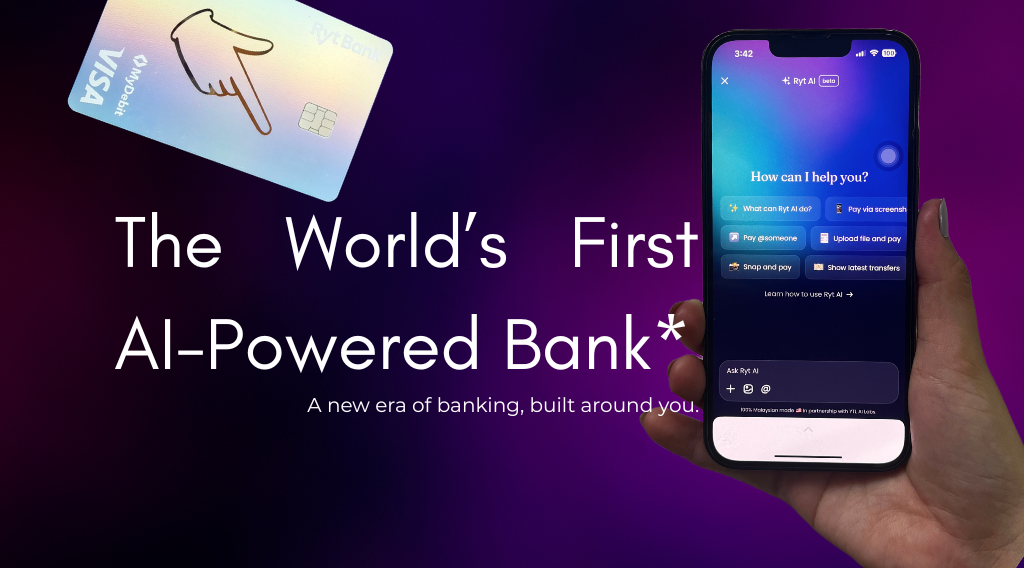
Backed by YTL and Singapore’s Sea Limited, Ryt Bank is making an ambitious promise to become the country’s first AI-powered digital bank.
By that, they mean the idea of placing an AI assistant at the centre of how people manage their finances, not just an app with a chatbot like SimSimi.
And before we begin, and before anyone asks about whether we can trust this bank, first and foremost, yes, Ryt Bank is fully licensed by Bank Negara Malaysia, and secondly, yes, the deposits are protected by PIDM up to RM250,000.
Now, shall we get to the meat?
Signing Up Feels Right at Home
The Ryt Bank app is already available on iOS and Android, with access gated by a waitlist. Luckily, I had the opportunity to go behind that and test the app. Now, let me give you guys a sneak peek at the app.
Onboarding takes less than two minutes, including eKYC, nothing to write home about. You have to snap a photo of your identification card, take a selfie, you know, the usual works.
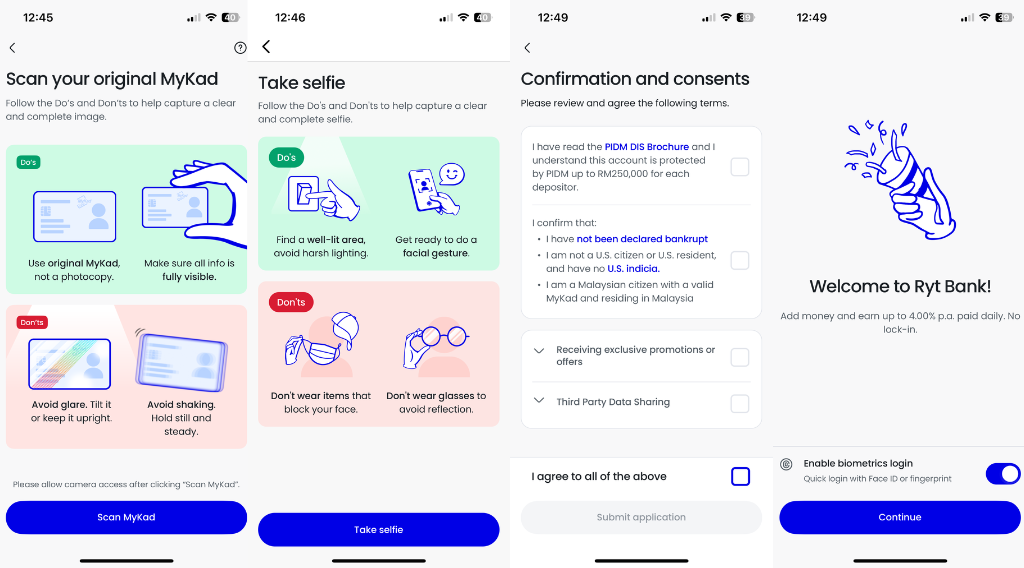
Then you have to key in your details, etc, and lastly, you have to browse through some declaration forms on confirmation/consent terms. And you’re all set up.
The process feels smooth, is quick, and okaylah, polished. Which is, to me, the bare minimum any banking app should be.
At its core, Ryt Bank delivers the basics you would expect. A savings account earns 3% per annum interest (up to 4% with Save Pockets, for your first RM20,000), credited daily. Even a few ringgit deposited will start accruing returns overnight.
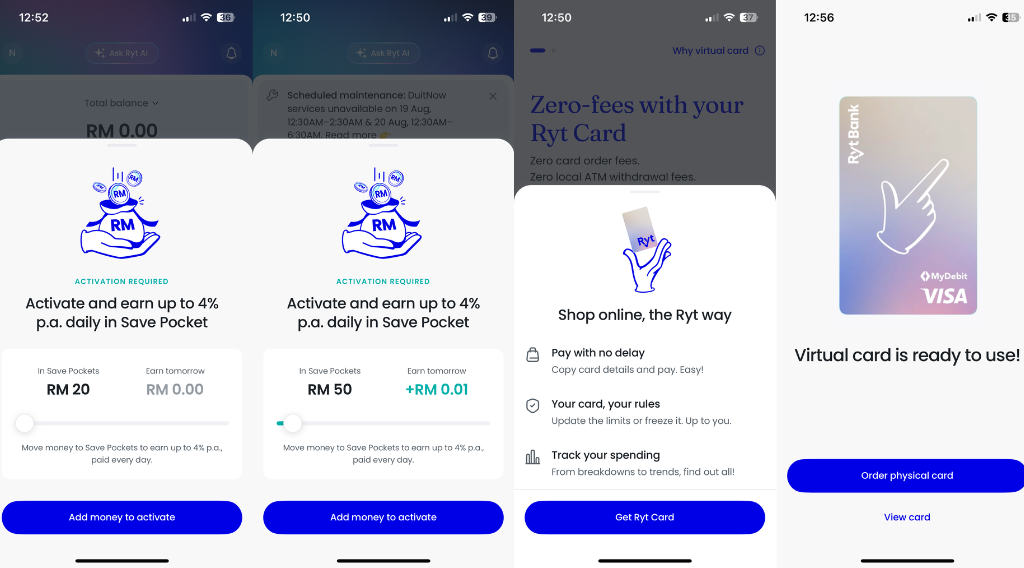
Users get an instant virtual debit card for online spending, and a physical Visa card can be ordered for free until the end of September. There is even a limited-edition Ryt card design for early adopters.
The app provides spending controls, freezes, and limits, with daily card usage capped at RM3,000 by default and adjustable to RM10,000.
Cash withdrawals are also available.
Domestic ATM withdrawals via MEPS are currently fee-free until September, while overseas withdrawals cost RM12 and enjoy a 1.2% unlimited cashback for foreign transactions, with the 2% foreign transaction fee by Visa being absorbed by the bank.
Ryt Bank also absorbs any form of foreign fees for all international spending.
The Good, the Bad, and the Glitches
So, what really caught my eye, at least, is how Ryt Bank has been raving that they are the World’s First AI-Powered Bank (in payments). What’s so AI about their app exactly?
Well, the app includes Ryt AI, an integrated digital assistant powered by YTL’s own ILMU large language model. As for what I can see, the bank is betting heavily on this to be the differentiator.
Ryt AI handles fund transfers, bill payments, and general queries using plain instructions or even screenshots. In testing, it felt intuitive. Easy to understand, easy to use.
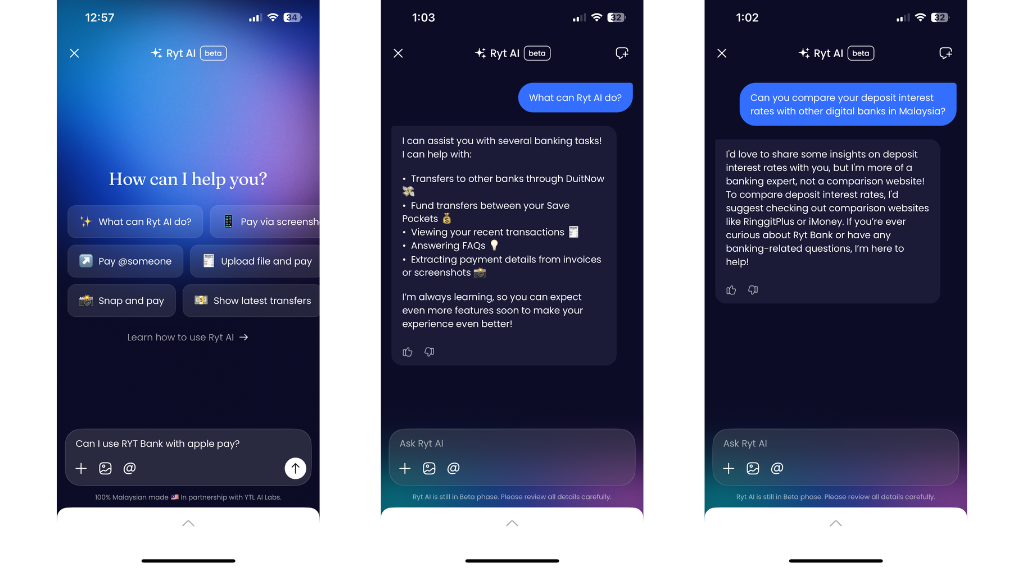
Typing “Transfer RM20 to CIMB account XXXXXXX” instantly prepared the transfer, leaving only a tap to confirm.
For DuitNow transfers linked to phone or MyKad numbers, it should perform similarly well, right? Not exactly.
Screenshots of personal DuitNow QR codes were not recognised, and the AI fell back on requiring a manual scan from the app’s home screen. Bill payments also showed gaps.
The AI did not support a PDF file of a TNB bill with JomPay unless it included bank account details.
I mean, it’s not flawless, but it still works.
It is best to note that Ryt AI is still in Beta, which explains the rough edges, but it shows the gap between the vision and the present reality.
Oh, and it works in Bahasa Malaysia too, but not in Mandarin nor Tamil. However, the latest updates from a close source are saying that Mandarin is set to be available by this September, but that is for the whole app, not Ryt AI.
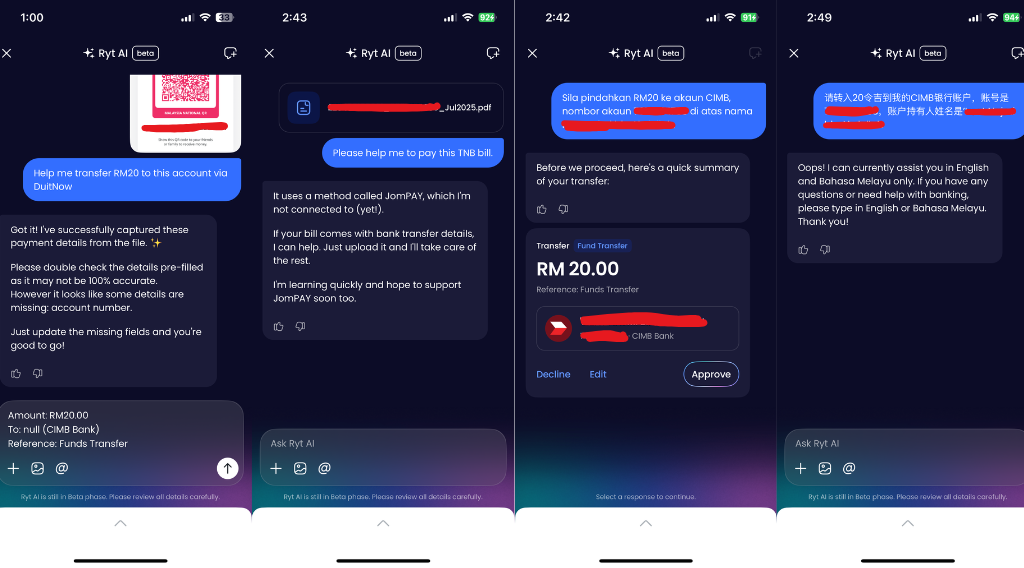
As illustrated in Photo 2, Ryt AI currently lacks a direct connection to JomPay, preventing it from paying those bills.
Photos 3 and 4 demonstrate that Ryt AI currently only understands commands in English and Bahasa Malaysia.
Can an App with AI Win Malaysian’s trust?
Ryt Bank is entering a competitive space.
GXBank has already captured early adopters, Boost Bank has the RHB partnership muscle behind it, and AEON Bank is carving out its niche as the country’s first Islamic digital bank. To stand out, Ryt Bank has put AI at the centre of its pitch.
In the late 1990s, Bill Gates uttered a phrase that sounded radical at the time:
“Banking is necessary, banks are not.”
Today, more than two decades later, those words have evolved from just a prediction to a near reality.
Ryt Bank’s experiment leans into that idea by suggesting that a bank does not have to look or feel like the institutions Malaysians have been growing up with.
If people only need the utility (to save, to pay, to transfer), then perhaps a digital assistant is enough. The challenge lies in whether Malaysians will trust AI to do the job for them or not.
Banking has always been about trust, and Ryt Bank’s challenge is proving that trust can extend to an AI assistant.
Its September launch will be the first real test, and if it delivers, Ryt Bank could change expectations of what a banking app should be.
If it stumbles, it may be remembered as the bank that tried to put AI in the driver’s seat before Malaysians were ready.
Watch our podcast with Ryt Bank’s Chief Product Officer, Foong Chee Mun, as he cuts through the AI hype and reflects on what this technology really means for society, creativity, and the future of financial services.
Featured image: Edited by Fintech News Malaysia based on images by Mateus Andre via Freepik, and Fintech News Network.
