



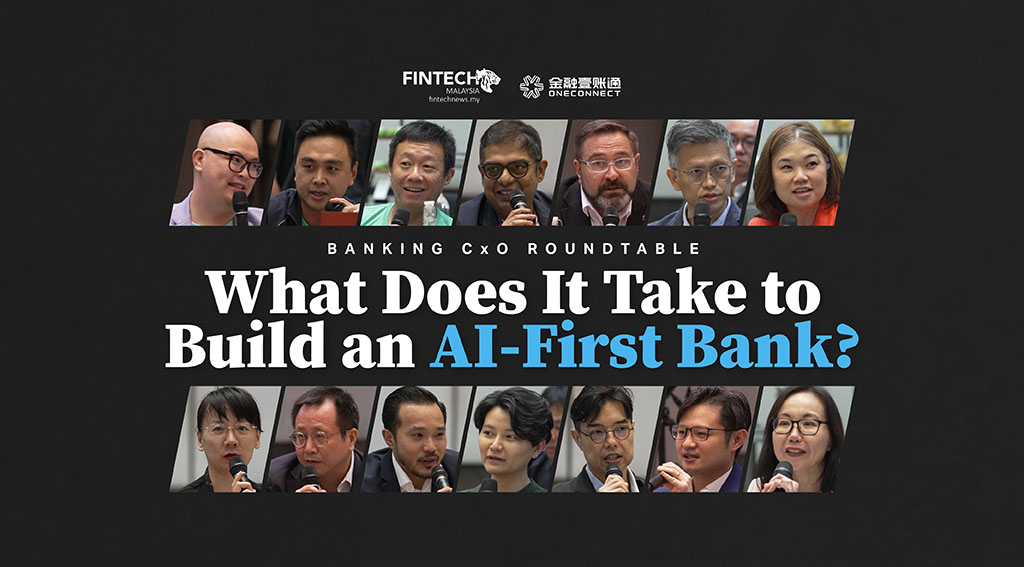
Everyone talks about building an AI-first bank. But what does it really demand? Put Malaysia’s top digital and incumbent bank leaders in one room, and you get the kind of raw clarity the rest of the industry rarely sees.
That was exactly the atmosphere at the recent Malaysia Banking CxO Roundtable, where the country’s newest digital bank joined familiar industry faces to dissect what “AI first” truly means in practice.
This mix of product leaders, technologists, marketers and operators offered a rare cross-functional view of what AI adoption really looks like inside a bank beyond the headlines and bold claims, including one institution’s ambition to become the world’s first AI-powered bank.

And with a recent MIT study showing that more than 95% of Gen AI pilots globally have failed, the stakes and scrutiny have never been higher.
Inside Ryt Bank’s Bet on Natural Language
Nic Ngoo, Chief Technology Officer of Ryt Bank, shared that one mistake they have faced is the tendency to “think too big”.

“We have too big of a scope when it comes to using some of this new technology. The key is to be very specific about the problem we’re solving and how to break down some of the phases and different use cases.”
Chee Mun Foong, the Chief Product Officer of Ryt Bank, elaborated that as the latest digital bank launched in Malaysia, Ryt Bank wanted to have something that is differentiated.

“From a secular trend standpoint, we are at a juncture with a once-in-a-lifetime opportunity to reinvent the human-computer interface. That is what we were reimagining when we started building the Ryt Bank app. For the first time in human history, we are able to tell the computer to do something using natural language instead of computing language.”
Chee Mun explained that this was previously impossible until LLMs came into the picture. What Ryt Bank set itself into was designing and completely bypassing the regular user interface construct, switching it to the natural language we use daily.
He divulged that after a while, the realisation also set in to gate their releases, as human behaviour changes can trickle in.
OneConnect Weighs in on the Growing Fraud Crisis
Next, Vincent Fong, Chief Editor for Fintech News Network, turned the discussion to Sam Altman’s recent comments about banks facing a fraud crisis on Bloomberg.
Matthew Chen, Chief Executive Officer for OneConnect Financial Technology, noted that the issue is pressing. He spoke about this region specifically, saying,
“According to some stats, more than 65% of threat actors are of Chinese origin.”

Matthew added that OneConnect, drawing on its unique background as an associate of Ping An Group, has built extensive experience in dealing with these threat actors and understanding how they operate.
The company also works closely with the public security bureaus, government agencies and telecommunications companies. He adds,
“You need a lot of collaboration because you can never prevent anyone from attacking. People are attacking all the time, and they have very good AI.”
Front-End Reinvention or Back-End Precision?
Vincent pointed out that in the AI and GenAI space, most deployments are happening behind the scenes. The question posed to the room was simple: Are they thinking about more consumer-facing applications, and would consumers be ready for this kind of interface?
Kaushik Chowdhury, Chief Executive Officer at GXBank, says the next phase will be unquestionably multimodal. The real debate is not whether this shift will happen, but how quickly banks choose to bring it forward versus letting it unfold incrementally.

“It’s all about prioritising and figuring out what really is the sweet spot. And I think multimodal is something on the consumer app I am most excited about, because the interactions can be multiple. You can imagine so many contexts and use cases.”
He pointed to the Ryt Bank app as a glimpse of what this future could look like, a product shaped by technologists who had both the benefit of timing and the boldness to ride the wave of natural language and multimodal interaction.
In his view, it is one of the first real renderings of what next-generation consumer banking could feel like.
William Streitberg, Chief Information and Technology Officer at Hong Leong Bank, offered a counterbalance from a different vantage point.

“We need to see where we can use these newer technologies in the back-end to try and make the customer experience better. The interface, yes, but the turnaround time is very important to customers.”
He emphasised that while customer-facing improvements are important, turnaround time and quality of touchpoints still matter more.
William noted that Hong Leong Bank has been increasingly inspired by DBS’s philosophy, taking on a “phygital” approach. The bank is not going fully digital and believes that human interaction still plays a critical role. Empowering staff and the sales force with AI technologies may be where the most immediate value lies.
AEON Bank’s Feature Proves AI Can Drive Daily Engagement
When the conversation shifted to measurable outcomes, Glen Cha, Chief Technology Officer at AEON Bank, offered one of the clearest examples of AI delivering tangible, repeatable results.
Unlike the many pilots that stall or fail, AEON Bank considers itself “fortunate to be in the 5%” where AI initiatives are already producing the returns the bank set out to achieve.
From the outset, AEON Bank anchored its AI strategy on two mandates: improving financial literacy and deepening financial inclusion. The team chose a focused, high-utility use case, personal financial management (PFM).
PFM served as the bank’s first iteration of applied AI, launching with a machine learning model powering its budgeting tool. This foundational layer later enabled AEON Bank to introduce Financial Insights, a feature built on the same ML model but enhanced with a genAI component.
The system analyses a customer’s weekly and monthly spending patterns and then produces personalised messages written by the model itself, contextual nudges intended to improve financial habits. And the results, Glen shared, were “pretty encouraging.”
Before Financial Insights went live, more than 60% of AEON Bank’s active customers were already opening the app one to two times a week. After launch, that same group began logging in six to seven times a week, almost daily.

“If you zoom into the people who really lock in and view the financial insights that have been generated for them, it doubles. They will lock in and use our app.”
How AI Is Powering Modern Financial Services
When the discussion turned to the practical, day-to-day applications of AI, the room shifted from theory to a flood of lived examples.
Diana Boo, Chief Marketing Officer at Boost, highlighted how Boost’s first major deployment was a chatbot that solved 70% of all customer service tickets, reducing the volume of complex conversations handled by the customer excellence team.
This was followed, just days before the roundtable, by the rollout of a conversational voice AI sales assistant.

“Today, if you apply for a loan, an AI agent will call you and help you verify the loans you want.”
When a customer applies for a loan, the AI agent calls to verify key details, clarify needs and qualify the prospect. This allows Boost to send higher-quality, pre-screened leads to its business development team.
As Diana summarised it: marketing generates the leads, business development closes the deals, and AI optimises in funnelling quality customers.
AI also supports a broader set of functions across the company, including marketing optimisation, coding, tech risk and fraud control.
She added that long before obtaining a digital banking licence, Boost was already relying on AI for credit scoring in its digital micro-financing operations, giving it a foundational advantage as it scales new AI-driven processes.
A Sector Moving in Sync, with Each Bank Charting Its AI Path
As the evening drew to a close, the room shifted toward one final question: What will the next twelve months look like? What followed was a snapshot of an industry aligned in direction but diverse in execution.
For Ryt Bank, the first year ahead is literally its first year ever, and with that comes the freedom to form a certain level of relationship with AI agents, something they are designing towards.
AEON Bank’s focus is more grounded: solidifying momentum. After the success of its Financial Insights features, the next year will centre on building on customer-facing products.
CIMB’s next phase involves a few pillars, including agentic AI embedded into workflow automation and upskilling its workforce, driven by like a past “promathon,” where hundreds of employees built chatbots in a event itself.
Across all these perspectives, one sentiment tied the room together: Malaysia’s banking sector is moving in remarkably similar directions, even if their timelines, ambitions and risk appetites differ. Every institution represented, digital or incumbent, is experimenting, learning and recalibrating.
And for an industry where pilots often fail, the collective willingness to test, iterate and share lessons openly is its own signal of maturity.
If you want the whole story, not just the highlights, watch the complete Malaysia Banking CxO Roundtable on How to Build an AI-First Bank below. Alternatively, read insights from the Philippines AI CxO Roundtable here.
