As digital payment activity expands, financial institutions are also taking a closer look at technologies that can support more complex transaction workflows.
Blockchain has entered that conversation gradually, first in controlled pilots and targeted deployments where payments depend on clear conditions or predefined triggers.
Companies like Blox have focused their efforts in these practical settings, testing how the technology performs in specific situations rather than attempting broad changes to existing payment systems.
In this context, Blox began exploring how a Ringgit-denominated digital token could support specific payment and settlement use cases within controlled environments.
The Case for Building Blockchain with Ringgit, Not Dollars
Founded to develop blockchain-based financial rails for Malaysia, the company is building infrastructure that connects traditional financial systems with blockchain networks at an institutional scale.
Through the PayNet Fintech Hub, Blox is moving beyond proof-of-concept into infrastructure aligned with Malaysia’s broader digital finance ambitions.
The company’s journey began with a familiar challenge.
Cross-border commerce was expanding, but settlement systems remained slow, fragmented, and exposed to currency volatility.
At the same time, blockchain ecosystems were largely built on US dollar-denominated stablecoins, leaving local economies without native digital settlement layers.
For Ethan Chung, the gap was more structural rather than just technical.
Ethan Chung
“We thought to ourselves, why not create a Malaysian Ringgit stablecoin and allow developers in Malaysia to build for Malaysians,” said Blox CEO and Co-Founder Ethan Chung.
That idea led to the development of MYRC, a Ringgit-denominated digital token created to test how blockchain-based settlement could support tokenised assets and automated payment workflows.
Local currency infrastructure, Ethan argues, is not just about branding.
Without a local currency option, on-chain transactions could introduce currency risk that limits institutional adoption.
From Infrastructure to Real Use Cases
While MYRC provides the monetary layer, its real-world application comes through JanjiPay.
Developed in collaboration with digital agreement platform Janjilah, JanjiPay is a blockchain-based escrow system that automates conditional payments using smart contracts.
Traditional escrow services are often too costly and manual for individuals and small businesses.
“Traditional escrow is very expensive. Minimum charges can reach around RM1,000 per transaction,” he explained.
Smart contracts shift this dynamic by automating payment logic and reducing operational overhead.
Buyers lock funds into a smart contract, sellers gain assurance that payment is secured, and funds are released automatically once predefined conditions are met.
This creates a more balanced and transparent transaction process.
Beyond peer-to-peer marketplaces, the use cases extend to subscription services, milestone-based contracts, and consumer protection workflows.
This positions JanjiPay as a clear example of how blockchain infrastructure can translate into practical, everyday financial tools.
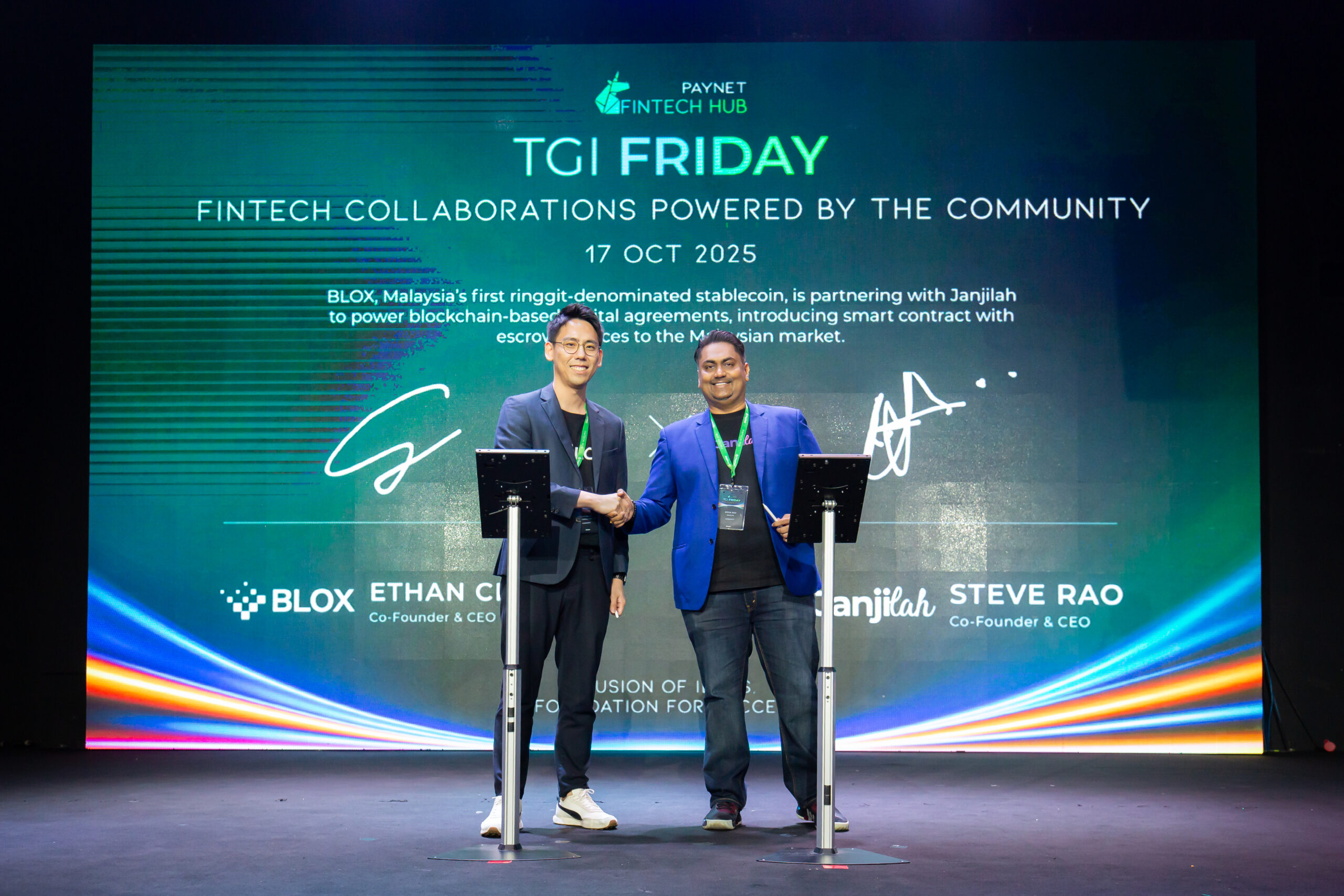
Ethan Chung and Steve Rao, Co-Founder and CEO of Janjilah, pictured at the PayNet Fintech Hub TGI back in October last year.
Working With PayNet and Industry Partners
Infrastructure-focused fintechs rarely succeed in isolation. Payment systems are shaped by regulatory frameworks, financial institutions and national infrastructure
Blox’s participation in the PayNet Fintech Hub reflects a deliberate decision to build within the ecosystem, not outside it.
“Through the PayNet Fintech Hub, we are able to directly communicate with the PayNet team and identify gaps where we can contribute,” Ethan said.
The Hub provides access to infrastructure insights, industry stakeholders, and feedback loops that would otherwise be difficult for an early-stage infrastructure company to obtain.
More importantly, it connects fintech startups like Blox directly to the national payments infrastructure, enabling solutions to be developed with real-world integration in mind.
This reflects PayNet’s broader role in enabling industry-led innovation, where fintechs, banks, and infrastructure providers co-develop solutions grounded in real market needs.
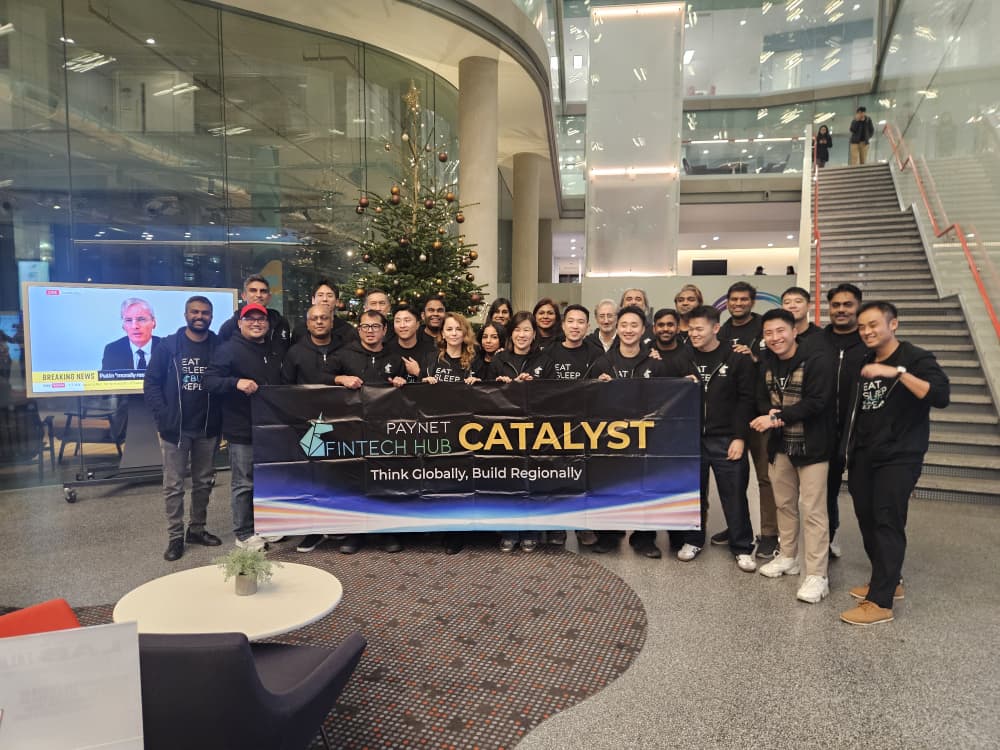
Ashwin Chockalingam, CFO and Co-founder of BLOX with Ethan Chung stands among others from the PayNet Fintech Hub CATALYST cohort.
Preparing for a Regional Playbook
Blox is also part of the PayNet x Imperial College London CATALYST programme, designed to expose Malaysian fintech startups to global mentorship and regional expansion frameworks.
The programme helped broaden the Blox’s strategic outlook beyond domestic deployment.
“They bring in mentors that have real, hands-on experience, offering a European perspective that has significantly broadened our thinking beyond domestic deployment and towards the wider Southeast Asia market,” he said.
That exposure has helped shape Blox’s regional roadmap, particularly in cross-border payments, interoperability and remittance.
Building the Foundation for What Comes Next
Engagement with the PayNet Fintech Hub helped Blox move its early experimentation into more structured testing environments.
The development of MYRC provided the technical foundation for exploring blockchain-based settlement, but the technology needed a practical use case to demonstrate its relevance.
That use case emerged through JanjiPay, a blockchain-based escrow system developed with digital agreement platform Janjilah.
By automating conditional payments through smart contracts, the project translated the underlying technology into a real transaction workflow.
Participation in the PayNet Fintech Hub then provided the bridge from concept to deployment.
“Once we joined the PayNet Fintech Hub, we found there are many gaps that can be addressed using blockchain technology,” Ethan pointed out.
At the same time, involvement in the CATALYST programme broadened the company’s outlook beyond local implementation, offering mentorship and international exposure that helped shape its longer-term regional ambitions.
What Malaysia’s On-Chain Future Could Look Like
Looking ahead, Ethan believes interoperability will be critical.
As financial institutions explore tokenised systems, fragmentation remains at l risk.
A common settlement and messaging layer would allow institutions to innovate without rebuilding infrastructure in silos.
For Blox, the focus remains on testing practical applications of blockchain technology and identifying where it can deliver measurable value within existing financial systems.
If programmable finance is to move beyond experimentation, infrastructure must come first.
The organisations building these foundations today will determine whether Malaysia’s digital finance ecosystem evolves as a cohesive system or fragments into disconnected platforms.
Through the PayNet Fintech Hub, early blockchain ideas are moving closer to real-world deployment.
For innovators ready to move from concept to real-world testing, the next step may already be within reach.
Join them now.
This article is part of an ongoing series spotlighting Malaysian fintechs building the future of finance through the PayNet Fintech Hub. Discover the Hub and more fintech startup journeys from Insureku, Cashku, Janjilah, Swipey, Kapitani, Blox, and Moby.
Featured image: Edited by Fintech News Malaysia based on an image by vitaliiw001x via Freepik.