




“It’s like a drug.”
That’s how a Redditor described their descent into the Buy Now, Pay Later (BNPL) rabbit hole. As a fellow BNPL user myself, I get where he’s coming from.
BNPL is everywhere now, tucked into your checkouts, flashing at your payment page, and dropping innuendos that splitting a payment into three or more helps stretch your bank balance. It’s a convincing illusion, and for a lot of Malaysians, that’s exactly where it starts to unravel.

The fine print never announces itself, and the effective interest rates don’t come with a warning label (yet, at least). Don’t forget that there’s also the slow creep of overlapping instalments snowballing and eating into a bigger chunk of your paycheck, way before you’ve clocked in to see your savings balance.
We all have our own relationship with money, and I’m not here to lecture anyone on theirs. But I do strongly believe in financial prudence, and that belief nudged me to put down my honest thoughts on two PayLater products I’ve been using lately.
As always, remember: the buyer, even the one who’s paying later, has to stay aware of their choices.
Last updated: 22 September 2026
How Does Atome Work in Malaysia?

Atome’s short for “Available to Me”, and we all know it as the digital financing platform that lets shoppers split their purchases at selected merchants, online and offline, into three interest-free payment options. If you prefer a longer repayment plan, you can do that at a “small” service fee.
In Malaysia, Atome is one of the most recognisable names in the BNPL space, and for good reason. Atome’s strength has always been its lifestyle-first merchant lineup, including fashion, beauty, and travel. That breadth is a perk.
Glancing into its app, Atome’s overview gives me a clear picture of my PayLater, Atome Card and its next anticipated product, i-Cash, an Islamic financial option based on Tawarruq.
Coupled with Atome+, its rewards plan, which allows Atome users to benefit from redeeming rewards, instant cashbacks and gamification features under Atome Town, Atome makes a pretty compelling case as a Malaysian BNPL provider.
What My Experience Was Like Using the Atome Card in Malaysia
I’ve always been intrigued by how a BNPL-based card would work and whether the experience would be smooth sailing. Atome’s the first provider I came across offering this in Malaysia, and I joined its waitlist a couple of months back.
A few weeks ago, I opened the app and noticed applications were open. I put mine in, and three days later, I got approved for an Atome Card.

The virtual card was approved immediately, but my enthusiasm dipped after a few hours of having the card. I’m someone who defaults to QR payments, so finding out that the virtual card is limited to online purchases only at Visa-accepting merchants was a bit of a letdown.
It’s not a dealbreaker, but it does narrow how you can use it day-to-day until the physical card kicks in (if you opt for it).
That came about a week later for me, and things improved noticeably from there. With Visa reporting that 96% of stores in Malaysia now accept real-time payments, prepaid cards included, I had plenty of room to put the card through. From 99 Speedmart to Shell, it worked without a hitch.
The app experience itself is clean and functional. However, the Atome card screen separates “bills” and “recent transactions” into two distinct sections, which sounds logical, but created a slightly confusing experience for me.
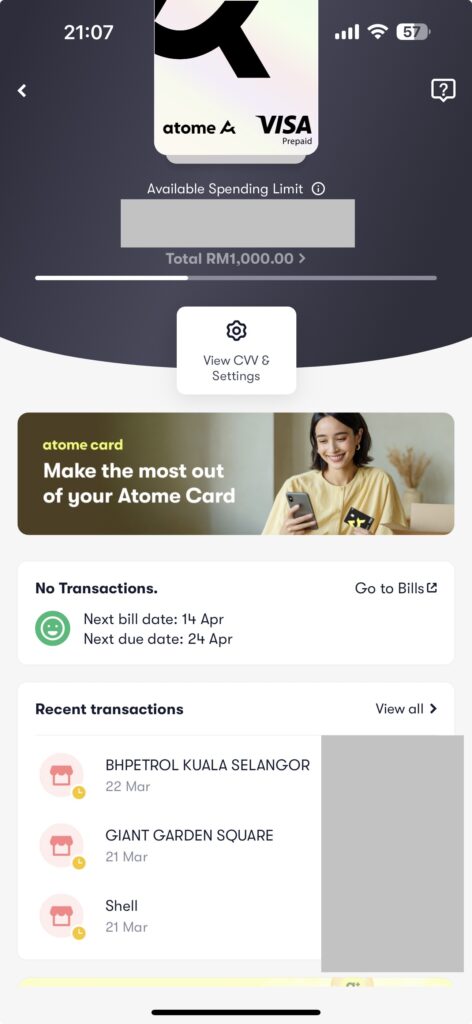
You’ll see a “no transactions” message in the billing section, while your recent purchases sit just below it. It took me a beat to understand what that meant (it refers to “bills” as the current billing cycle, which has no confirmed charges yet), and I suspect it could trip up less tech-savvy users.
On the upside, the next bill date and due date are clearly surfaced, which is a thoughtful touch for anyone prone to missing payment deadlines.
Atome Still Has Room to Grow, But the Foundation Is Strong
What I’d perhaps like to see from Atome more? A higher spending limit, for which I’m willing to share income documents, for starters. As it stands, the card comes with a total limit of RM1,000 for me, which works for small, frequent purchases like petrol or groceries.
But the moment I’m eyeing anything slightly bigger, I’ve got to do mental gymnastics to keep tabs on my remaining balance.
I’m still early into my journey with the Atome card, but I’m hoping that it holds onto its promise to increase my spending limit over time if I play nicely, too.
All in all, the Atome Card is a solid first step into the BNPL card space in Malaysia. The in-store experience is largely seamless, and the app does its job. But between the modest spending cap and a few UX quirks, it still feels like a product that’s inching closer to finding its footing.
I’ll be watching closely to see how Atome iterates on it, as the potential is clearly there.
How Does Ryt Credit Work in Malaysia?

Ryt Bank is Malaysia’s first AI-powered digital bank. Backed by YTL Digital Capital Sdn Bhd and Sea Limited, Ryt Bank positions itself as a “digital bank that blends global standards with local expertise for solutions that work for Malaysians.”
Ryt Credit, formerly Ryt PayLater, is the bank’s BNPL feature, offering a credit line of up to RM1499 that can be activated instantly with no documents required. Users can also opt to apply for a higher Ryt Credit limit of up to RM100,000, which requires them to submit their EPF statement.
The higher-limit option is not available to gig workers, KWAP users, and self-employed customers at the moment.
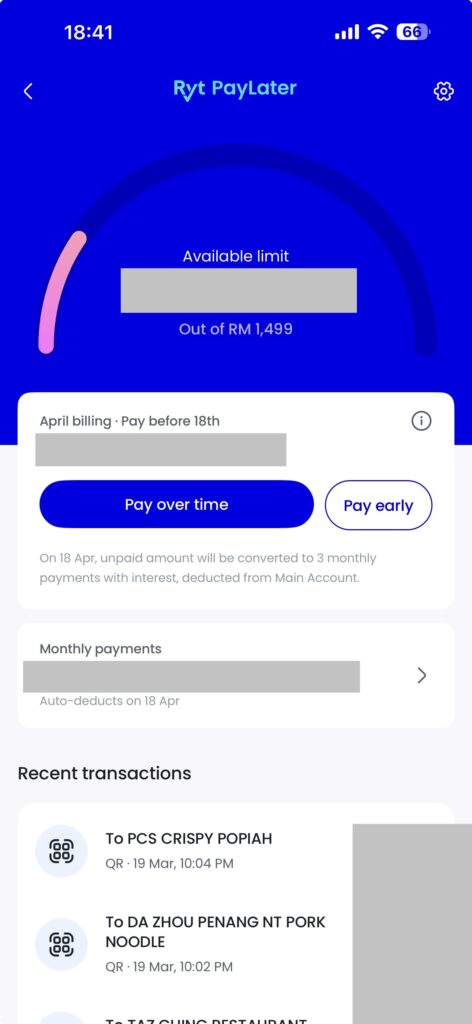
If you opt to pay your due before your due date, you’d be charged 0% interest. In the event you miss your payment, it’ll be automatically converted into monthly instalments (which you can opt for up to 12 months ahead of time) with no late fees incurred.
Monthly repayments are spread out over a span of 3, 6, 9, 12 or 24 months, with effective interest rates running at 26.8%, 30.23%, 31.32%, and 31.72% per annum, respectively, before 23 September 2026. After this date, converted balances will be charged with an effective interest rate of 31.72% for the same tenures.
What My Experience Was Like Using Ryt Credit
What makes Ryt Credit stand out from other BNPLs is its default payment behaviour. Once you activate the feature, the Ryt app allows you to set Ryt Credit as the default account for QR payments.
You can switch between Ryt Credit and your Ryt savings account, which I find serves as a bold product nudge to get you into its credit use, while also being refreshingly transparent about it.
Another key differentiator I found myself leaning into was its AI-powered identity, which I could use to clarify anything on Ryt. Ryt AI works as advertised, and I was able to chat my way through some of my concerns about using the Ryt Credit feature.
The feature still runs on a beta version, and it’ll be interesting to see what’s up next with Ryt Credit and Ryt AI.

If I were unclear on how to use the Ryt Credit solutions on Ryt AI, I could still find the information on its website under Ryt Credit basics or by navigating the app itself.
Ryt Credit Is Standing Tall, But It Has A Long Way To Go, Too
Ryt Credit’s got a pretty solid model in place IMO. The Ryt AI feature feels more like a natural extension of how we’re already interacting with LLMs, and it’s nice to get financial answers without the usual runaround for OTPs, pressing different numbers to reach a human consultant and everything else.
Going into its interest rates, the 0% interest starting offer is genuinely appealing, but it comes with a catch worth noticing. Sure, if you miss your payment, you won’t be facing late payment charges. But your balance auto-converts into a 3-month instalment plan without you lifting a finger, too.
Whether that reads as a safety net or a nudge into debt depends on your financial standing, but either way, your effective rate jumps from 0% to 31.72% per annum (soon) the moment it kicks in. This may not be unusual territory for BNPL products, but it’s the kind of thing that consumers should go into with their eyes open.
That said, where I’m most curious to see Ryt Credit develop is its credit-building angle. If Ryt follows through on unlocking higher limits as your repayment history strengthens, this could shape up to be the rare Malaysian BNPL product that grows with you.
So, Who Wins?

We started this journey by calling BNPL a drug. By now, it’s clear that Atome and Ryt Bank are just different delivery systems that hit the same dopamine of “buy now.”
Atome’s strength lies in its reach. With the Atome Card, especially, you’re no longer limited to “selected merchants”, as you have the universal power of Visa in your hands.
However, be prepared for the “new user handicap.” If you’re looking to fund something as expensive as a fridge or a gaming laptop, Atome Card’s low starting limit might leave you stranded at the checkout.
The bigger frustration? If you wanted to switch from Atome Card to Atome PayLater itself, oftentimes you won’t know your exact spending power or lack of it until the moment you pay at the merchant’s end. That “limit anxiety” is a significant stumbling block that Atome may try to smooth out with its upcoming i-Cash product.
On the flip side, Ryt Credit wins hands-down on the slicker experience. Because it’s baked directly into your DuitNow QR flow, using it feels invisible, and that’s precisely why you need to be careful, too. It’s probably one of the reasons why Ryt was the most downloaded app in Malaysia as of February 2026.
The Ryt Credit “no late fee” promise is a bit of a “Trojan horse” effect. While you avoid the immediate sting of a flat penalty, any missed payment triggers an automatic conversion into a 3-month instalment plan, which can knock you down.
That said, Ryt Credit is the perfect tool for the tech-native who lives on QR payments, provided you have the ironclad discipline to use it responsibly.
As a consumer in 2026, the best financial “drug” is still acute financial awareness. Use BNPLs to manage your cash flow when the need arises only, and never let the “Pay Later” button outrun your “Earn Today” reality.
All views expressed in this article are my own and based on my personal experience. This content is provided for informational purposes only and should not be considered financial advice. Readers are encouraged to conduct their own research and exercise financial judgment.
Featured image edited by Fintech News Malaysia based on an image by sebdeck on Magnific
