



A RM1,000 BNPL balance is almost 59% of Malaysia’s RM1,700 monthly minimum wage, a level that the bottom 10% of formal employees were earning at or below in September 2025.
If you are earning minimum pay, does that still sound like a small debt?
At the national level, the picture looks very different as by the end of 2025, Bank Negara Malaysia (BNM) found that BNPL accounted for just 0.3% of total household debt, even though outstanding balances had reached RM4.9 billion.
Small nationally, perhaps but the people using BNPL tell another part of the story.
More than 70% of BNPL users in Malaysia come from the B40 income group.
So when we say BNPL makes up only 0.3% of household debt, does that figure tell us enough about the burden on the people actually using it?
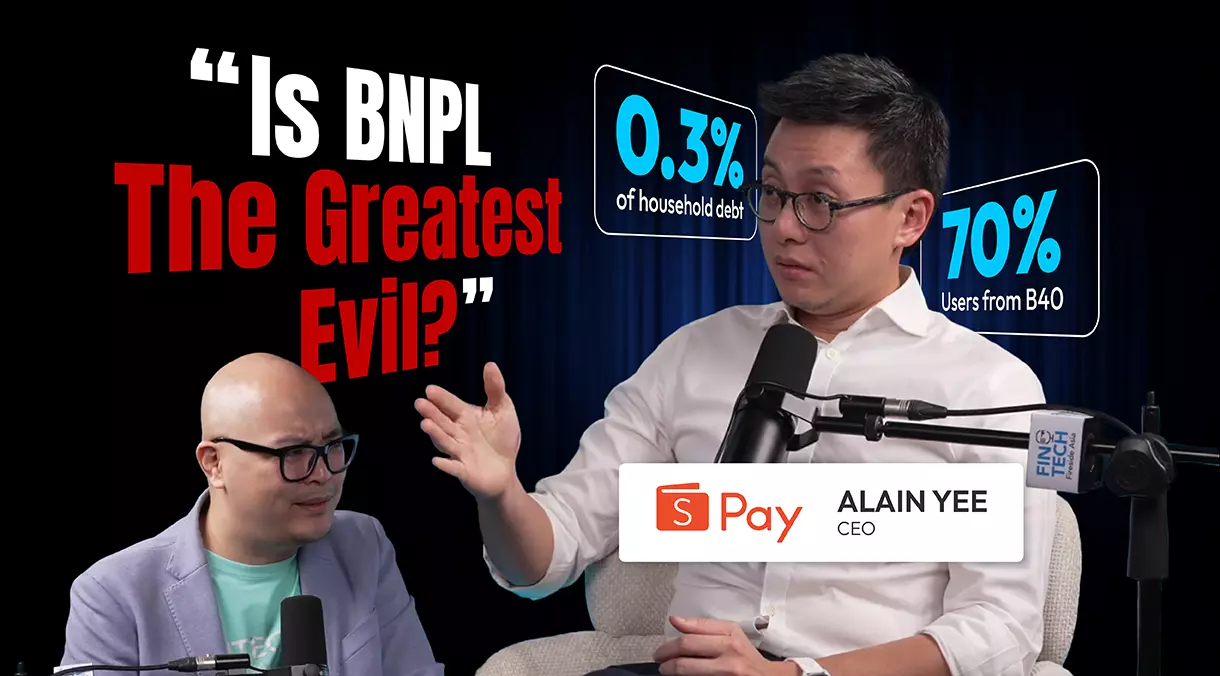
The same tension came up during a recent conversation between ShopeePay Malaysia CEO and Head of Monee Malaysia Alain Yee and Fintech News Network’s Vincent Fong.
Alain pointed to BNPL’s 0.3% share of household debt to argue that the sector remains very small compared with mortgages and car loans.
But Vincent looked at it from the borrower’s side.
A RM1,000 balance barely registers against Malaysia’s total household debt. Someone earning RM2,000 a month still has to find half a month’s salary to clear it.
“So while the number is small, the impact is very big, right?” Vincent asked, to which Alain replied, “Fair.”
The market itself has grown quickly.
Malaysia had 5.1 million active BNPL users at the end of 2024, with most aged between 21 and 45 and earning below RM5,000 a month which may have resulted to how BNPL transactions reached RM7.1 billion in the second half of that year alone.
By the end of 2025, BNM counted 7.5 million active BNPL accounts. The share of overdue balances stood at 3.2%, while the central bank said the sector’s rapid growth still warranted close monitoring.
And the growth has come with consolidation.
Grab’s proposed purchase of a 60% controlling stake in Atome Financial for about RM6.08 billion (US$1.49 billion) would bring together two sizeable consumer credit businesses.
The transaction is expected to close by the third quarter of 2027, subject to regulatory approvals.
Alain sees it as part of a shakeout that had already begun.
“We saw one round of BNPL players actually shutting down because they couldn’t make it work,” he recalled.
The players left standing, in his view, usually had access to a bigger pool of customers or merchants.
Scale matters because the business model depends on who is willing to absorb the cost of instalments.
Some providers rely more heavily on merchant fees, while others recover more of that cost from users, so having a large commerce or payments network gives them more room to make the model work.
A company attached to a wider commerce or payments business has more customers and merchants to work with, giving it more ways to make the economics work.
RM91 Buys More Than Gadgets
Talk about BNPL and expensive phones, electronics or impulse purchases often come to mind.
However, Malaysian spending patterns are not quite so neat.
The average BNPL transaction was only RM91 in 2025, with food, groceries, transport and services among the common uses. Malaysia’s latest BNPL figures show how far the product has moved into everyday spending.
KFC Malaysia introduced a three-month BNPL option through Boost Credit’s QSR PayFlex in 2025 with Starbucks had already been offering instalment payments through Atome.
A phone paid over several months is easy enough to associate with BNPL but a fried chicken paid over three months makes the conversation rather different.
Does that mean people are recklessly financing dinner? Not necessarily. It does show how close BNPL has moved to everyday consumption.
Vincent questioned whether that convenience could eventually become a financial crutch.
Spreading a payment over several months may relieve pressure today without addressing whatever caused the shortfall.
Alain acknowledged the concern, although ShopeePay’s own research suggested some users had few other places to borrow.
Around 70% of users polled by the company reported having no access to other forms of formal credit.
ShopeePay has not publicly released enough detail for that figure to be independently verified, so it should be read as the company’s own survey finding.
Alain also challenged the way lower-income borrowers can be judged by whatever appears on the transaction.
He recalled one customer who used BNPL to buy an electric scooter.
Seen only as a purchase, it might look discretionary because some of the customers used it to commute to work and reduce transport costs.
Would the purchase look as frivolous once you know what it was being used for?
RM91 tells us how much somebody spent, but what it didn’t tell us, is why?
Miss a Payment, and the Credit Stops
What happens when someone cannot keep up?
SPayLater freezes further spending once a payment becomes overdue.
“If you miss your bill by one day, your entire SPayLater account gets frozen, so you can’t spend anymore,” Alain explained.
Shopee’s current terms state that late payments can result in an account being frozen, with a late charge of RM10 or the principal bill amount, whichever is lower.
Credit limits provide another control.
Alain described borrowers with little conventional credit history starting with limits as low as RM200. He put the average SPayLater credit limit at around RM1,000 to RM2,000, although individual limits vary.
A repayment behaviour can then inform later credit decisions.
His commercial argument was straightforward.
“We actually cannot make money … if we extend a line of credit to individuals that cannot repay.”
ShopeePay had also deliberately kept relatively quiet about its credit business before Malaysia’s Consumer Credit Act became clearer.
Alain described credit as a “double-edged sword” and said the company had consciously avoided talking too much about lending while the regulatory framework was still taking shape.
The Consumer Credit Act 2025 came into force on 1 March 2026, while licensing requirements for BNPL providers took effect on 1 June.
The Consumer Credit Commission gave providers a six-month transition period to comply.
Such repayment history could matter outside the BNPL app too.
Alain expects ShopeePay to report customer information to a credit reporting agency once the required licensing process is completed.
The Consumer Credit Commission (Suruhanjaya Kredit Pengguna or SKP for short) has likewise told consumers that BNPL repayment records may be considered in future creditworthiness assessments.
BNPL may still feel lighter than taking out a conventional loan.
Increasingly, however, the consequences can follow borrowers much further than checkout.
ShopeePay Began With Checkout But Credit Became the Bigger Story
ShopeePay did not start out trying to become a lender.
When the e-wallet launched in Malaysia in 2019, Shopee had a much more immediate problem.
Mega-sale campaigns could send transaction volumes surging at midnight, and Alain recalled payment infrastructure struggling just as shoppers rushed to check out.
“So then the e-wallet was there to mitigate this problem,” he recalled.
SPayLater followed in 2021, with cash lending arriving in 2022.
The business has moved a long way since then.
When Vincent asked which part of Monee mattered most in Malaysia, Alain pointed to lending.
“I think lending because we have cracked to certain degree the product that people are willing to use or want to use and need to use,” he responded.
Sea’s group numbers give some scale to that answer.
Monee had about RM45.28 billion (US$11.1 billion) in consumer and SME loans outstanding at the end of June 2026, up 62.5% year-on-year.
Sea says consumer and SME credit accounts for most of Monee’s revenue and operating income.
So, When Does BNPL Stop Looking Like BNPL?
ShopeePay is already testing how far that credit business can go.
Vincent asked whether SPayLater might eventually come with a card or another card-based form factor.
Alain confirmed that ShopeePay is looking into it, partly because not every merchant accepts QR payments.
A card would widen where SPayLater could be used but the bigger change may be what people are financing.
Alain pointed to SPayLater Motorcycle, an unsecured financing product available to selected users. Applications can require proof of income, while repayment periods can stretch to 60 months.
“We’ll look into other verticals where it’s productive,” Alain told Vincent. “The important thing here is it needs to be [a] productive use case.”
A motorcycle loan is a very different commitment from splitting a RM91 purchase.
ShopeePay currently publishes a monthly profit rate of 0.92% for SPayLater Motorcycle.
Its own example shows RM10,000 financed over 60 months attracting RM5,500 in profit charges, taking total repayment to RM15,500.
Alain’s earlier electric scooter example helps explain why ShopeePay is interested in this kind of financing. A vehicle can help someone get to work or reduce commuting costs.
The commitment lasts much longer too.
BNPL grew by making smaller purchases easier to spread across several pay cycles. Cards, multi-year tenures and bigger-ticket financing push the idea considerably further.
At what point are we no longer talking about a checkout feature, and simply talking about credit?
Intriguing, isn’t it?
Watch the full conversation between Vincent and Alain on Fintech Fireside Asia for more on Malaysia’s BNPL market, ShopeePay’s approach to credit and where Alain thinks the business could go next.
