



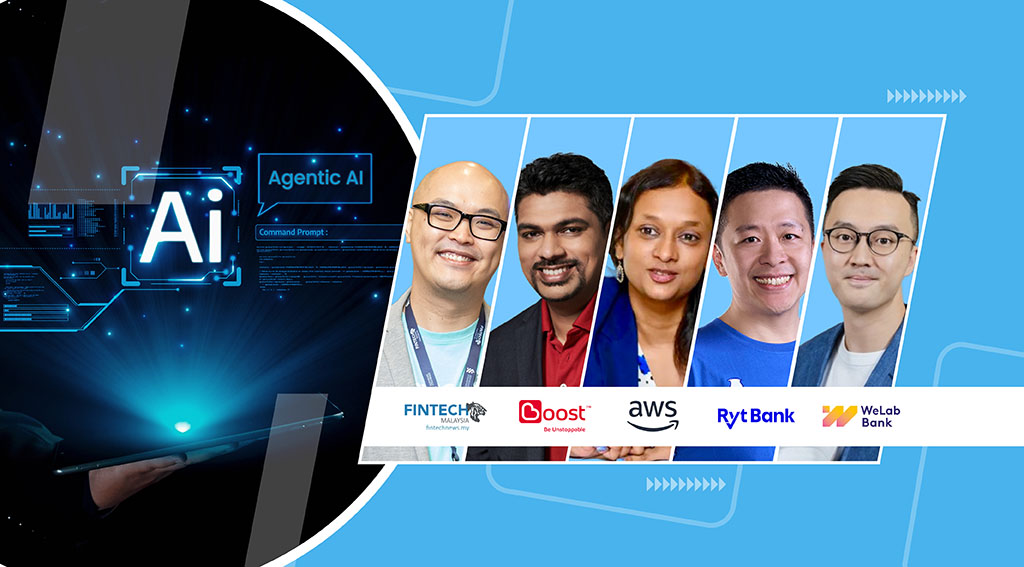
Why Trust Will Define Agentic AI Adoption in Financial Services
According to Sheyantha, the idea of giving AI a degree of agency wasn’t new, but it only became vogue with the advent of large language models (LLMs).

These systems brought reasoning and contextual understanding that far surpassed earlier machine learning algorithms, allowing AI go beyond analysing data and to reason, decide, and act.
“We realised that we have something more powerful in terms of reasoning and cognitive capability, where we can give our tasks, agency and decision making rights over.”
While this was indeed a big inflection point, Sheyantha was quick to point out that that the real challenge isn’t the technology itself, but the trust and risk appetite required to adopt it.
He drew a clear distinction between low-risk, high-friction tasks like onboarding, account opening, or wallet top-ups, where customers are more accepting of automation, and high-stakes decisions such as investment management, where confidence and control might still matter deeply.
“When it comes to adoption, especially decision rights that are more personal to both management in companies and also to customers, it’s really about how comfortable people are. That’s how I see the adoption curve unfolding.”
Humans With AI Will Replace Humans Who Don’t
Artificial intelligence is advancing so rapidly that established companies are scrambling to define their roles within it. But with that rush comes risk. Former IBM CEO Ginni Rometty has long cautioned that embracing AI is a matter of trust and stewardship.
Companies that fail to train AI responsibly or understand its limits could jeopardise their most valuable asset: their reputation.

Melvin echoes that sentiment but sees opportunity where others see risk. Quoting Rometty, he reminded the audience that AI will not replace humans, but humans with AI will definitely replace humans who don’t.
“For the first time in human history, we have something smarter than us,” he said. “The question now is how do we use that tool to make things better?”
At Ryt Bank, the answer begins and ends with customer centricity. Melvin described AI as a force multiplier that helps the bank “work harder for the customer, not the other way around.” Every design choice, he explained, is guided by a single question: how can the customer get more by doing less?
That philosophy is reflected in Ryt Bank’s bold positioning as the world’s first AI-powered bank, where users can make payments or check balances simply by chatting with the system through an LLM-powered interface.
The response, according to Melvin, has been overwhelmingly positive, with a high rate of returning users and survey results showing over 80-90% satisfaction with the Ryt AI experience.
“We also start with something more within the comfort level. Rather than everything automated, everything done by one single command, we actually let them (the customers) do it on the process. But when it comes to the decisioning, we always stop there and say, do we want to confirm? That way, they always feel that they are in control.”
That small but deliberate design choice turns complex financial interactions into simple, conversational ones “like telling your assistant to make a payment”, as Melvin put it, while preserving the reassurance that the human remains in charge.
WeLab’s Lesson on Turning Agentic AI into Effective Practice
Tat believes that agentic AI is swiftly moving from a futuristic concept to a practical foundation for the financial services industry, but he cautions that the transition is far from automatic.
He offered an analogy that captures his philosophy: AI agents are like interns, highly capable, tireless, and fast learners, but still in need of proper guidance and supervision.

“You may not be able to rely on the AI agent itself to solve a industry issue, unless you provide a lot of training optimisation and fine tuning. Deploying AI also requires a holistic approach, to infuse the AI agent into different parts of the workflow and the process. So it’s not straightforward.”
To him, success with agentic AI comes down to how effectively banks break down complex workflows into smaller, repeatable tasks that AI agents can take over. In Hong Kong, Tat sees that transformation already gaining momentum.
“AI adoption is one of the key topics of most banks (in Hong Kong), and particularly from the regulator’s perspective.”
He pointed to the sandbox environment established by the Hong Kong Monetary Authority (HKMA) as a crucial enabler. It provides banks with a safe space to test and refine AI-driven use cases before full-scale rollout.
Comprehensive Governance Will Define the Next Phase of Agentic AI
Taruni has a front-row seat to how banks across Southeast Asia are approaching agentic AI, and she sees a spectrum of readiness as broad as the region itself.
“The spectrum of customers that we cover is pretty broad, from your heritage traditional banks to your digital banks.”
She adds that one of the underlying challenges lies in the multi-generational mix of clients. While a 25-year-old may readily use AI to make a payment, someone slightly older might view it as a hurdle, a gap where trust becomes a defining factor.

At AWS, Taruni says the focus is on bringing primitive principles back to the forefront: treating an agent as part of the digital workforce. That means training it, monitoring it, and enforcing guardrails around its actions, which she believes is equally, if not more critical than the use cases themselves.
“We’re seeing a lot of customers moving from prototypes and sandboxes to production, and that element of how you make sure this has longevity in the application use case is critical. What happens six months later when a policy changes?”
To ensure that longevity, AWS takes a holistic approach, running AI implementation like any other enterprise operation, measured by the principles of safety, trust, and governance. In line with this, AWS set up an Agentic AI Task Force in March to accelerate innovation.
Where Could Agentic AI Take Financial Services Next?
Together, their message was clear: agentic AI’s future will be shaped not by how intelligent it becomes, but by how responsibly we let it decide, learn, and act on our behalf.
Want to explore the full discussion? Watch the full webinar on Youtube, where the panel unpacks how trust, governance, and customer design will define the next phase of agentic AI in financial services.
Featured image: Edited by Fintech News Malaysia, based on the image by Frolopiaton Palm on Freepik
