




The conventional expectation is that uncertainty drives a flight to familiarity.
The Malaysia SME Business Outlook 2026, a study commissioned by Airwallex, suggests otherwise: more Malaysian SMEs say uncertainty is pushing them towards digital and fintech platforms than back towards traditional banking.
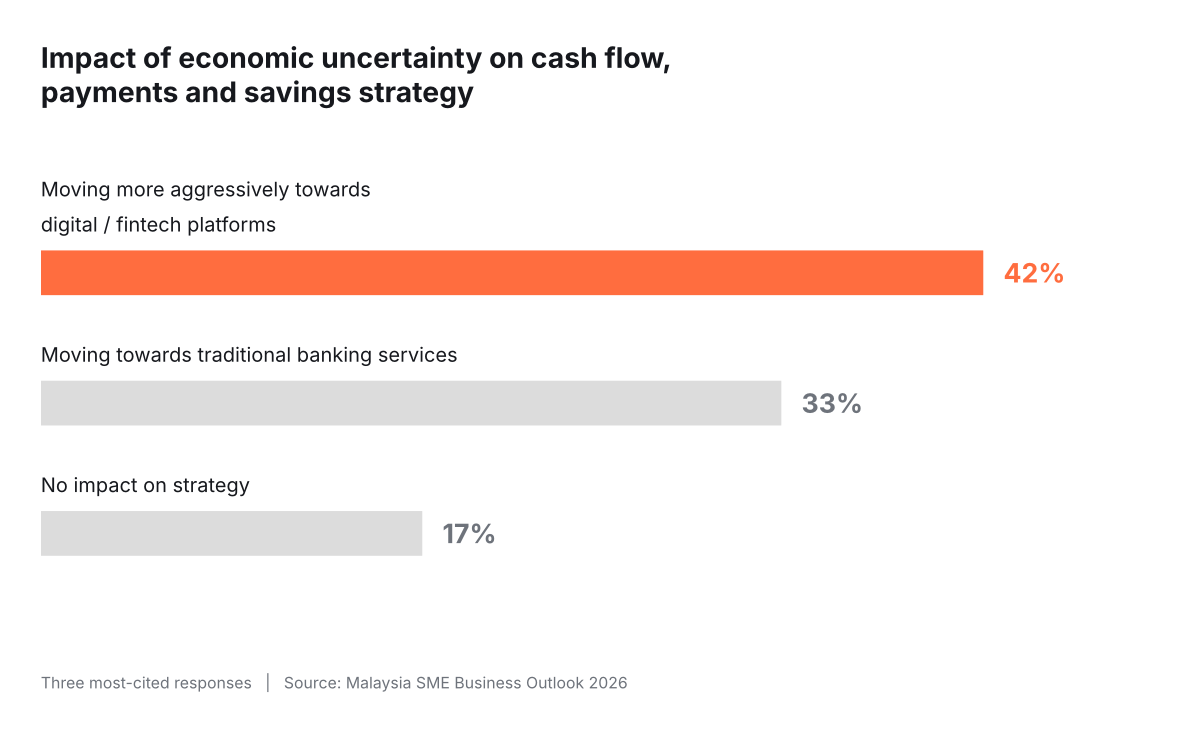
When asked how the economic environment is shaping their approach to cash flow, payments and savings, 42% of respondents said it was moving them more aggressively towards digital and fintech platforms. Just 33% said it was moving them towards traditional banking services, and 17% reported no impact on strategy at all.
The research drew on over 400 SME respondents in Malaysia across a range of sectors, conducted in H1 2026. It covered business growth and spending, rising costs, technology, expansion, financial operations, digital and fintech adoption, and workforce priorities.
More Than Half Have Already Adopted Digital Finance
Of the businesses surveyed 54%, have already adopted digital or fintech platforms to support their financial needs. A further 37% have not, and 9% were unsure.
Among businesses that have adopted digital or fintech platforms, the reasons are largely operational. Faster transactions led at 66%, followed by convenience at 64% and cost savings at 53%.

Distrust of fintech platforms is rare among those surveyed. 39% said they trust them somewhat and 22% completely. Just 2% said they did not trust them, while 32% were neutral and 5% were not aware of such platforms.

What Still Holds the Rest Back
According to the study, among businesses that have stayed with traditional banking, 72% cited familiarity and trust, 55% pointed to better security and 40% to lower fees.

Set against the 2% who say they do not trust fintech platforms, these figures suggest inertia rather than preference, pointing to a gap that providers have yet to close rather than a settled choice.
Cost Pressure Is Forcing a Harder Look at Systems
Rising costs were the most-cited pain point for SMEs in the survey, named by 67% of respondents, ahead of availability of suitable manpower at 43% and managing cash flow at 42%.
The biggest drivers of those rising costs were the cost of goods or raw materials at 25%, rising costs from suppliers at 20%, and technology and software costs at 16%.
Businesses are responding on several fronts. The leading responses are finding alternative suppliers at 47%, restructuring at 41% and optimising operations through technology at 38%.
This is happening without a retreat from growth. Revenue growth remains the leading business priority at 57%, followed by improving efficiency at 55% and innovating or introducing new products and services at 35%. On spending, 29% expect to increase slightly and 24% significantly, while a further 25% expect to hold steady.

“Economic uncertainty isn’t holding Malaysian SMEs back from adopting digital finance, it’s accelerating the shift. With rising costs putting pressure on businesses, SMEs are increasingly looking to technology to manage cash flow, improve efficiency and make every ringgit work harder,”
said Andrew Chim, Head of Southeast Asia Expansion at Airwallex.
He said that meant looking beyond topline growth at the systems underneath the business, from how businesses manage costs and cash flow to where technology can remove friction and improve efficiency.
Technology is central to that conversation, with the technologies businesses rate most important spanning marketing and finance: marketing capabilities at 50%, expense management at 42% and accounting software at 42%. Meanwhile, the biggest challenges when selecting technology are high implementation costs at 44%, data privacy and security concerns at 34%, and a lack of internal expertise to manage new tools at 33%.
Overseas Expansion Is Where Infrastructure Gets Tested
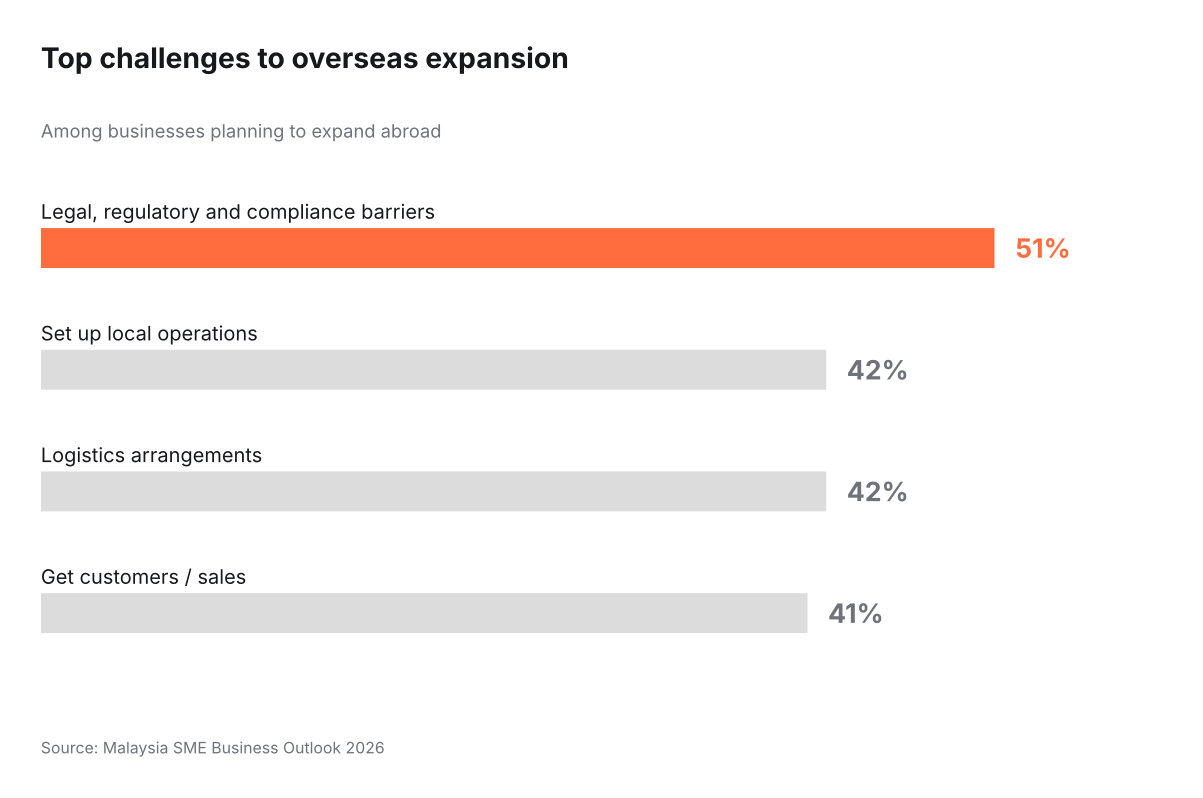
When it comes to overseas expansion, the most-cited challenges faced by Malaysian SMEs were legal, regulatory and compliance barriers at 51%, ahead of setting up local operations and logistics arrangements at 42% each, followed by getting customers or sales at 41%.
The financial picture mirrors it. Compliance with local regulations was the most significant cost-related risk at 44%, followed by logistics and shipping costs at 42% and setting up local entities at 38%.
Businesses are funding that expansion through a mix of sources, led by investors at 58%, partnerships and affiliates at 51%, and reinvesting profits at 40%. Their expansion strategies centre on expanding marketing activities at 63%, establishing new partnerships at 61%, and team growth or hiring and sourcing new customers, both at 55%.
“Ambition is rarely what holds Malaysian SMEs back from expanding overseas. The real challenge lies in navigating regulations, setting up local operations and managing payments across multiple markets,”
Chim said.
He pointed to registering an entity, meeting local compliance requirements and moving money between markets without losing sight of it, and said those were infrastructure questions worth answering before an expansion rather than during it.
How Airwallex Supports Malaysian Businesses Expanding Overseas
With Airwallex now readily available for Malaysian businesses to run their financial operations, its local account details and licences allow businesses to collect and pay out in local currencies without first setting up a local entity or traditional bank account in each market.
In April 2026, Airwallex received regulatory approval from Bank Negara Malaysia for its e-money issuing and Class A licences, allowing it to provide a complete suite of payment services to businesses in Malaysia, from payment collections and cards to international payouts.
In addition, Airwallex has also continued to invest in its local presence, citing Malaysia as one of the region’s most dynamic and digitally advanced economies.
In 2025, the global financial and payments platform grew its Malaysian team by 66% and currently intends to double its headcount in 2026 after expanding into a new office space with capacity for over 160 employees.
Founded in Melbourne in 2015 and now co-headquartered in Singapore and San Francisco, Airwallex is valued at US$11 billion as of June 2026, with plans to continue deepening its footprint across Southeast Asia, including Malaysia.
Featured image credit: Edited by Fintech News Malaysia, based on image by toia via Magnific
