




Digital payments have become more of a routine for most Malaysians.
You can use it to clear tolls, parking, meals and even use it to pay your bills. The transaction completes almost instantaneously.
It is so seamless that almost all of the users do not even think about the technology enabling those moments.
TNG eWallet started as a digital payment solution for everyday transactions, particularly offline QR payments across transport, retail and small merchants.
Today, it has evolved into a broader financial and lifestyle platform that integrates payments, financial services and everyday services within a single app, operating at a scale that reaches the majority of Malaysian adults.
Behind this user experience lies a complex reality: the need for a database infrastructure capable of handling the unpredictable volatility of a national digital economy.
For TNG Digital, this meant moving beyond traditional databases to a solution designed for massive scale and resilience.
Reliability at that scale depends on careful engineering decisions made long before a payment is processed.
With over 26 million verified users, representing 85% of Malaysian adults, relying on its platform, TNG Digital operates in an environment where system performance directly affects everyday life.
Even a brief slowdown can disrupt thousands of transactions within minutes.
Keeping services stable during peak demand has therefore become a central responsibility for the company’s technology leadership.
For Leslie Lip, the CTO of TNG Digital and his team, the challenge extends beyond building new features. For him, sustaining performance under constant growth requires a disciplined approach to infrastructure.

“The challenge for us is not to focus on just being okay … but the day-to-day challenge is more on how we are able to sustain such a large volume of transactions, especially during peak hours.”
As adoption increased across Malaysia, usage patterns grew more complex.
Payment spikes began to occur without warning, often triggered by promotions, seasonal campaigns or government initiatives.
Maintaining reliability under those conditions became essential, pushing TNG Digital to rethink how its core systems were designed.
Faced with the limitations of legacy infrastructure, the organisation knew it needed a partner capable of delivering the financial-grade reliability required for a large-scale digital backbone.
This was not just a technical upgrade; it was a strategic decision to future-proof the platform against exponential growth.
When Rapid Growth Began to Strain the System
Periods of intense demand tend to reveal structural limits that remain hidden during normal operations.
For TNG Digital, that realisation came during a national digital stimulus campaign, when users attempted to access incentives at the same time.
Like many platforms during large-scale national campaigns, traffic surged rapidly, response times slowed, and systems that had previously handled growth comfortably began to show signs of stress.
That incident marked a turning point.
“That is the first time that we realised that the current design, the current architecture and the current tech platform that we are doing is actually not enough and it is far from the expectations towards where we want to go.”
This moment of realisation highlighted a fundamental truth: incremental fixes were no longer viable.
So, engineers within TNG Digital examined the underlying architecture more closely.
Their findings suggested that incremental adjustments would only delay the next disruption and because of that, a more fundamental redesign was necessary.
Tracing the Source of System Bottlenecks
Early troubleshooting efforts focused on application performance and network behaviour, plus a deeper analysis of their systems, eventually pointed to a more persistent constraint.
The database layer, which handled the majority of transaction requests, had become the primary bottleneck.
High transaction volumes meant the system was constantly reading and writing data.
Plus, as concurrency increased, response times began to stretch.
“Most of the time, the performance issue of the bottleneck always comes from the database.”
Addressing that bottleneck became critical for maintaining service reliability.
Users expected payments to work instantly, regardless of how many people were online at the same time. Any delay risked undermining trust in the platform.
Operational expectations added another layer of complexity.
Software updates were released frequently, and each change had to be implemented without interrupting transactions.
Scheduled downtime was not considered acceptable for a system used throughout the day.
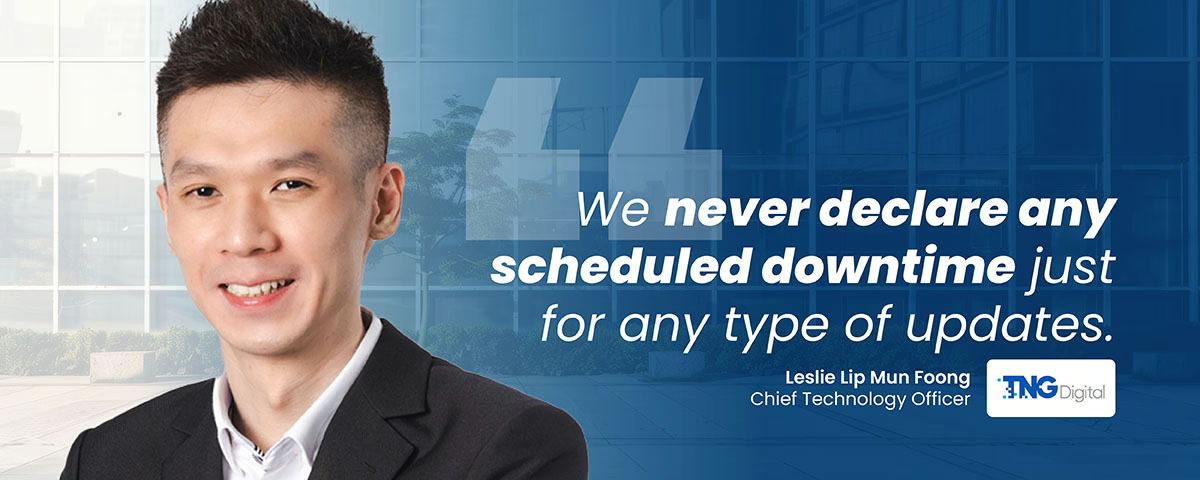
Meeting that standard required infrastructure capable of supporting constant change while maintaining consistent performance.
In other words, this bottleneck was not just a technical hurdle; it was a barrier to business growth.
Redefining the Role of the Core Database
As transaction volumes continued to climb, the technology team began reassessing what a modern payments database needed to deliver.
The goal was not simply to increase speed.
Reliability, scalability and operational flexibility had to improve at the same time.
Several priorities emerged during internal planning sessions. Systems needed to distribute workloads automatically, adapt quickly to traffic spikes and remain operational even if one cloud provider experienced an outage.
Managing those risks required a more resilient architecture.
“We cannot depend on just one cloud service provider for a critical system.”
The evaluation process led the team to adopt OceanBase as the platform supporting its distributed database environment.
One of the immediate advantages was the ability to partition data automatically across multiple nodes.
That capability reduced the manual effort previously required to manage database scaling.
Handling peak demand became significantly more predictable once data distribution was automated.
“Manual sharding was impossible at this scale. OceanBase’s native distributed architecture eliminated this bottleneck automatically.”
The shift also enabled a multi-cloud deployment strategy.
Instead of relying on a single infrastructure provider, the platform could operate across different environments without redesigning applications.
That flexibility strengthened system resilience and reduced operational risk.
Maintaining Reliability While Releasing New Features
Digital platforms must evolve continuously, yet reliability cannot be compromised in the process.
Maintaining that balance requires infrastructure capable of supporting upgrades without interrupting active transactions.
Earlier database systems often locked data tables during structural changes.
Even minor modifications could temporarily block new transactions, forcing teams to schedule updates during low-traffic periods.
That approach became increasingly impractical as usage expanded.
For a digital wallet processing thousands of transactions per second, downtime is not an option.
OceanBase’s high-concurrency processing engine was the game-changer here.
The new architecture allowed engineers to perform updates while transactions continued to flow through the system.
To validate the system’s resilience, the team conducted stress tests simulating extreme workloads.
“We actually stress tested 40,000 transactions in one second … and during this time we did table modifications … it’s proven that it will not jam the table, so the transactions can continue to go on.”
This capability allows TNG Digital to innovate at speed, releasing new features without ever disrupting the flow of money—a critical advantage in the fast-paced fintech landscape.
Testing discipline remained a critical safeguard. Every code change, regardless of size, underwent performance validation before deployment.
“Every single release, we actually run performance tests, no matter how minor or major.”
Scaling Infrastructure Without Letting Costs Spiral
Rapid growth inevitably increases data storage requirements.
Regulatory obligations often require financial institutions to retain transaction records for extended periods, which can significantly expand infrastructure costs over time.
Managing that growth required careful planning.
Beyond performance, the business case for the new infrastructure hinged on cost efficiency.
OceanBase’s advanced compression technology directly addressed this financial burden.
Engineers introduced a data lifecycle strategy that separated active records from historical information.
Older data was archived while remaining accessible for compliance and auditing purposes.
This approach reduced the processing load on live systems and helped maintain predictable operating costs.
Compression technology provided an additional efficiency benefit by reducing storage consumption.
“We have 10 gigs of data, but once we put inside the database, it can help you to compress 50% or even more than that.”
This efficiency allows TNG Digital to retain critical historical data for compliance and analytics without letting infrastructure costs spiral, turning a technical upgrade into a clear financial win.
Building Infrastructure for a More Digital Southeast Asia
Digital adoption across Southeast Asia continues to accelerate as consumers rely more heavily on mobile payments and online services.
Financial platforms increasingly operate as essential infrastructure rather than optional convenience tools.
In Malaysia, digital wallets already support daily activities ranging from transportation to retail purchases.
Reliability expectations have therefore risen significantly.
System failures are no longer isolated technical incidents. They affect businesses, commuters and public confidence in digital services.
Leslie believes infrastructure planning must reflect that reality.
“The wallet that we are doing now is critical system.”
Technology teams across the region are facing similar challenges.
Systems must scale quickly, recover from disruptions and support new services without compromising performance.
Distributed architectures and multi-cloud deployments are becoming central to that effort.
Platforms capable of adapting to rising demand will be better positioned to support the next phase of digital transformation. It is for this reason that OceanBase is increasingly emerging as a preferred database solution.
The Engineering That Keeps Payments Running
Behind every seamless payment is a network of engineers monitoring performance, refining systems and preparing for the next surge in demand.
Reliability does not happen automatically. It is the result of constant testing, careful planning and ongoing investment in infrastructure.
For Leslie and his team, the objective remains straightforward even as the platform continues to expand.
He said that the reason behind this is not because of shortcuts or quick wins, but the consistency required to keep systems running reliably at scale.
“How we actually expand so fast and push so many new products … is really because we work very, very hard,” Leslie uttered.
This partnership between TNG Digital and OceanBase is not just about technology; it’s about building the resilient backbone of Malaysia’s digital future.
While users enjoy the seamless experience, TNG Digital is now leveraging this robust foundation to accelerate its fintech ambitions.
Growth will continue. User expectations will rise. Transaction volumes will increase.
Maintaining stability under those conditions will depend on infrastructure designed to evolve alongside the business.
That work rarely attracts attention from users, yet it is what makes digital payments feel effortless every single day.
Upgrading to a distributed database is quickly becoming the regional standard.
OceanBase currently empowers some of the most prominent digital wallets in Southeast Asia, providing the exact stability required to keep platforms like GCash and TNG Digital online for millions of concurrent users.
This article first appeared on Fintech News Singapore
Featured image: Edited by Fintech News Malaysia based on an image by mkmult via Freepik.
