From RM1, Janjilah Brings Blockchain Proof to Everyday Digital Agreements
Scam challenges sparked the creation of Janjilah, a blockchain-powered digital agreements platform that transforms everyday transactions and verbal promises into legally binding, immutable records.
Get the hottest Fintech Malaysia News once a month in your Inbox
Malaysia’s online marketplace has a shady secret.
Every day, hundreds of micro-entrepreneurs complete deals on social media, Carousell, and digital storefronts, armed with nothing but messages and hope. But when something goes wrong, trust breaks down just as quickly.
When a buyer ghosts or a seller disappears, those screenshots rarely qualify as proof in the eyes of the local authorities.
The collective cost for scams here is a bitter pill to swallow. Malaysians lost RM542 million to scams in 2025, with only RM34 million ever recovered.
Steve Rao, the founder and CEO of Janjilah, experienced this “trust deficit” firsthand during the pandemic. After falling victim to multiple online scams, he realised that the barrier was documentation that could showcase proof.
“I realised that no one wants to sign an agreement, even if it’s on WhatsApp.”
When Steve spoke to the authorities about the issue, he discovered another bottleneck. The police couldn’t act on complaints because they had nothing verifiable to validate.
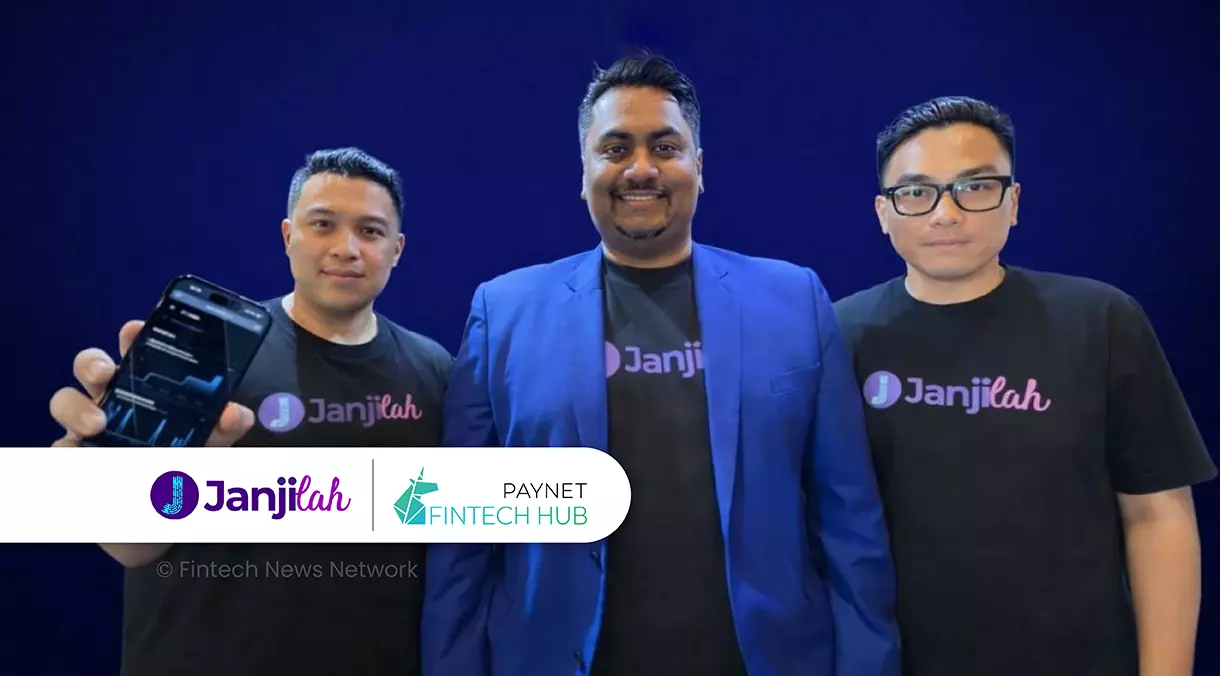
This missing link between what people experience and what authorities can recognise sparked the creation of Janjilah with fellow co-founders Amir Azril and Yew Jin Tan, a blockchain-powered digital agreements platform that transforms everyday transactions and verbal promises into legally binding, immutable records.
The Proof Problem in Informal e-Commerce
At the heart of the issue is a regulatory grey zone. The problem, Steve explains, sits between a scam and a dispute.
While the authorities largely defined scams within banking and financial crime frameworks, some of the digital marketplace was plagued by informal friction that fell into the cracks.
A buyer receiving a broken product and being refused a refund? Not really a scam. A service provider ghosting his client after taking the payment? A civil matter.
For traders caught in between, the lack of systematic documentation means justice is often out of reach, and the cost of legal recourse far outweighs the value of the transaction.
At its core, the issue has always been proof and the lack of a reliable, time-stamped trail of events.
Steve Rao
“A lot of people don’t know how to create agreements,” Steve explains. “Generally, they don’t know where to start or how to do it. That was the first pain point we wanted to solve.”
The second pain point surfaced quickly. Even when traders had proof, the authorities couldn’t use it. Unsigned WhatsApp messages, screenshots and unverified identities made it nearly impossible to trace who was on the other end of a deal or transaction.
Police would ask for a name, contact number, or printed documentation, yet most informal traders didn’t have systematic records.
What became clearer was that this was a structural issue. Through conversations with government agencies and potential users, Janjilah uncovered a broader opportunity.
For many of these businesses, mobile phones are the primary tools of commerce, with little access to formal financial infrastructure.
Designing for a Mobile-First Segment
Responding to those realities required more than a lightweight digital form.
Janjilah’s design choices flowed directly from who it was built for. According to Janjilah’s research, around half a million Malaysian micro-SMEs run entirely on mobile. The apps they use every day are primarily Instagram, Facebook, and WhatsApp.
That ruled out building a native app, as asking traders on a low-storage phone to download something they might only use a few times a month is pushing them to not download it.
“For them to download an app, it must be something they use every day,” Steve says, drawing on his experience working in Africa, where 8GB phones were the norm during the pandemic.
Janjilah was built as a web app instead, accessible from any phone with a browser and available in English and Malay. Users can go to janjilah.com and click through the login page, or open app.janjilah.com for the web application.
Privacy was another deliberate constraint. Janjilah cannot see the contents of an agreement signed between two parties. Only the existence of the agreement, the verified identities of the signers, and the timestamp are visible on the platform. Everything else stays between the two parties.
“It was designed in such a way to ensure privacy, so that nobody can access it or demand access from us,” Steve says.
That principle carries into how police and enforcement agencies use the system. Janjilah has built a separate portal for authorities, allowing them to verify that an agreement took place between two named parties on a given date and to confirm its validity, without ever seeing the underlying terms.
The complaint itself still has to come from the user, but what changes now is that the user has a record that the authorities can act on.
Getting that record into traders’ hands at scale, next, meant rebuilding the platform itself.
The Hard Call to Rebuild the Platform From Scratch
In 2025, Janjilah rebuilt its platform from scratch, an executive decision Steve made to ensure that the platform was fast, reliable, and built to institutional standards.
The new platform reduced agreement signing time from 15 seconds to five and introduced 14 localised templates developed around the everyday transactions of Malaysia’s micro-SMEs. Use cases ran from buy-sell agreements and service contracts to gig and part-timer employment contracts, tenancy agreements and more.
All users need to do is open the Janjilah web app, pick a template, fill in the details, and sign off. The receiving party signs for free.
Both parties get identical copies with blockchain-verified timestamps, downloadable as PDFs and accepted for reporting to authorities, including the Consumer Tribunal.
After studying high-volume transaction behaviour across Malaysian platforms, the team arrived at a simple conclusion: convenience in Malaysia has a clear pricing ceiling.
“Five ringgit (per agreement) felt too high,” Steve says. “Malaysians love affordable things. So we went lower. One ringgit.”
The fee started from RM1 per agreement. By pricing below the psychological hesitation threshold, Janjilah became accessible enough for micro-SMEs while remaining credible to institutions to take seriously.
Also, as every agreement is timestamped and KYC-verified on blockchain, authorities can confirm that a transaction took place without needing the parties to produce their own evidence.
In effect, Janjilah turns informal commitments into records that authorities can recognise and act on.
This capability aligns closely with Malaysia’s broader anti-scam initiatives led by a collaborative, multi-agency effort with Bank Negara Malaysia, PayNet, Polis Diraja Malaysia and more.
The Right Backing at the Right Time
For Janjilah, translating ambition into scale required the right partner.
Janjilah joined the PayNet Fintech Hub in 2025 at a critical time. Two integrations were essential to unlock mass adoption: electronic Know-Your-Customer (eKYC) onboarding to speed up user registration, and LHDN eStamping to enable formal stamp duties on agreements like tenancy contracts.
These integrations were necessary to unlock the SME and MSME adoption, segments identified by government agencies as national digitalisation priorities.
However, the cost and development timelines posed a major barrier. eKYC platforms were expensive, involving factors like AWS for scaling, developer time, and would take up as much as 2 years to realise.
“PayNet gave us an integration fund for our platform, which is great,” Steve reflects. “There was no heavy demand from us, except for us to be better in terms of what we were doing.”
While funding was part of the puzzle to solve, what Steve valued most was the strategic matchmaking.
“The PayNet Fintech Hub knows exactly what we do and how we think. They helped us accelerate our plans by eight months to a year.”
Through the Hub, Janjilah connected with potential corporate partners and government agencies aligned with their mission. It introduced them to other members solving complementary problems, like Blox, a stablecoin and blockchain solutions provider.
Together, Janjilah and Blox are collaborating on JanjiPay, an escrow product designed specifically to provide traceable, blockchain-backed payment protection for consumers and small businesses.
The PayNet Fintech Hub also provides co-working space, shared services, and positions fintech startups within a community of fintechs, banks and infrastructure partners, all working towards the same goal: building a more inclusive community.
“Not many agencies give you these facilities. They may come with some strings attached or require you to pitch for them. With the PayNet Fintech Hub, the way they have structured things makes it straightforward and accessible.”
The fintech was one of the 10 startups chosen for the PayNet x Imperial College London CATALYST Programme, which combined an immersive campus experience with nine weeks of virtual mentorship from global fintech leaders.
For Steve, who has more than a decade of experience in blockchain and digital identity systems, the programme illuminated for him on thinking regionally from day one.
The mentorship covered cybersecurity in an AI-era threat landscape, cross-border expansion strategy, and capital deployment across SEA markets. One insight that struck Steve was that the venture capital narrative most SEA founders default to does not match the actual funding flowing into the region.
“These are insights you can only gather from sessions like that. It changed the way we’re thinking about fundraising,” Steve says.
While Malaysia remains Janjilah’s launchpad, ASEAN has long been the end goal. The primary challenge lies in navigating regulatory differences across markets.
“Janjilah started with Africa in mind, when I came back to Malaysia just before the pandemic. We have been talking to a couple of countries ever since, because our product is live and legally sound. We are still in the midst of getting that sweet spot. For other countries, it is a matter of different regulations. That is the only barrier right now, for us.”
Building the Legal Backbone of the Informal Economy
With sights set on Indonesia, the Philippines, Vietnam, and Singapore, Janjilah is preparing market-specific adaptations to meet local requirements.
Steve is already in discussions with regional governments about embedding Janjilah in specific segments, potentially positioning it as part of the official digital infrastructure for dispute resolution, contract enforcement, and commerce documentation.
While regulatory requirements in other countries may necessitate higher premiums than the initial RM1 price point here, the mission remains unchanged: making digital agreements accessible enough at a price that outweighs the risks of informal “handshakes” and scams.
The downstream impact is substantial. Micro-traders with documented transaction histories could become bankable, qualify for microloans, apply for government assistance programs, and eventually move into the formal economy.
Steve projects the platform reaching 50,000 agreements per day at full adoption across Malaysia’s informal economy, but the immediate milestone is more grounded: 1,000 daily transactions from the first wave of users.
More importantly, Janjilah represents a structural shift, where trust, proof and protection are built into Malaysia’s digital economy by design rather than treated as afterthoughts.
This article is part of an ongoing series spotlighting Malaysian fintechs building the future of finance through the PayNet Fintech Hub. Discover the Hub and more fintech startup journeys from IIMMPACT, InsureKu, Swipey, CashKu, Kapitani, Blox, and Moby.
Featured image edited by Fintech News Malaysia based on an image by Janjilah